


Healthcare organizations manage enormous volumes of data every single day. Patient registrations, clinical notes, lab results, discharge summaries, insurance claims, and compliance documentation form the backbone of healthcare operations. Yet, much of this data still enters systems manually or through semi-automated processes that depend heavily on human intervention. The result is predictable: delays, inconsistencies, transcription errors, and frustrated clinical staff spending more time on keyboards than with patients.
Automating healthcare data entry has emerged as a strategic priority, not as a cost-cutting exercise, but as a quality improvement initiative. When data flows accurately and in real time, care teams make better decisions, billing cycles shorten, compliance improves, and patients experience smoother journeys through the system. This is where AI and automation in healthcare begins to deliver tangible value.
Modern AI agents go far beyond basic automation scripts. They can interpret unstructured inputs such as scanned forms, handwritten notes, emails, PDFs, and voice recordings, convert them into structured data, validate information against existing records, and route it intelligently across systems. When combined with no-code and low-code orchestration platforms, healthcare organizations can deploy these capabilities without rewriting their entire IT landscape.
The shift toward healthcare automation is not about replacing people. It is about removing repetitive, error-prone tasks so skilled professionals can focus on clinical judgment, patient communication, and outcomes. This article explores how AI agents enable automated healthcare data entry, how no-code platforms accelerate adoption, how integration with existing systems works in practice, and how organizations can move forward with confidence.
Unlocking the Power of AI in Healthcare Data Entry

Artificial intelligence has changed how healthcare data is captured, processed, and validated. Traditional automation relied on rigid rules and structured inputs. AI agents, in contrast, operate with contextual understanding. They recognize patterns, adapt to variability, and improve performance over time.
One of the most immediate benefits of AI-driven data entry is the reduction of manual effort. Tasks that previously required staff to copy information from one system to another can now be handled automatically with high accuracy. This is particularly valuable in environments where information arrives in multiple formats.
- Extracting patient demographics from scanned intake forms
- Converting handwritten clinical notes into structured EHR entries
- Capturing lab results from PDFs or emails and updating records instantly
- Validating insurance details against payer databases
AI agents also bring consistency. Humans interpret data differently, especially under pressure. AI systems apply the same logic every time, reducing variation and improving data quality. When anomalies appear, such as missing fields or conflicting values, agents can flag them for review rather than silently passing errors downstream.
Another advantage lies in real-time processing. Instead of batch updates at the end of the day, AI systems update records as events occur. This ensures clinicians, administrators, and billing teams work from the same current dataset. In emergency or high-acuity environments, this can make a meaningful difference.
Over time, AI agents learn workflow patterns unique to each organization. They adapt to local terminology, document formats, and approval chains. This learning capability ensures that automation in healthcare remains aligned with operational realities rather than becoming another rigid system staff must work around.
Organizations exploring these capabilities often begin by understanding how AI agents differ from traditional automation. A useful reference is this comparison of AI agents and virtual assistants, which clarifies where autonomous agents deliver the most value.
Building AI Agents Using No-Code and Low-Code Platforms
One of the major barriers to adopting AI in healthcare has historically been complexity. Building custom integrations required specialized development teams, long timelines, and significant budgets. No-code and low-code platforms have changed that equation.
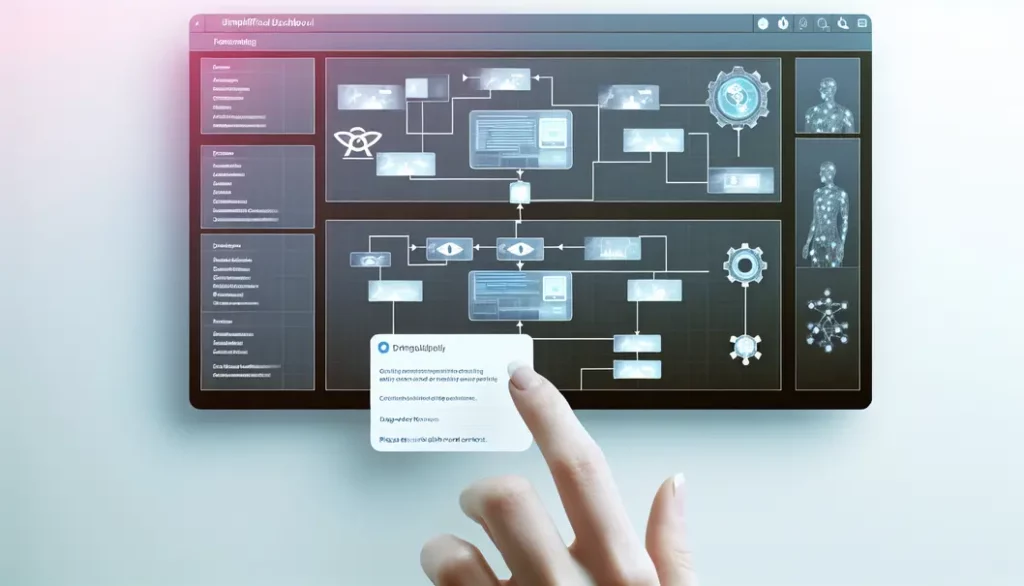
Platforms such as n8n, Make, and Zapier allow organizations to orchestrate AI agents through visual workflows. These platforms act as the connective tissue between AI models, data sources, and existing healthcare systems.
- Visual workflow design that mirrors real operational processes
- Pre-built connectors for databases, APIs, cloud storage, and messaging systems
- Event-driven automation triggered by new data, uploads, or system updates
- Human-in-the-loop checkpoints for compliance and quality assurance
Using these platforms, a hospital can design an end-to-end data entry pipeline without writing extensive code. For example, when a scanned form is uploaded, an AI agent extracts the data, validates it, updates the EHR, and notifies staff only if exceptions occur.
This approach reduces dependency on IT teams for every minor workflow change. Departments can refine processes as regulations evolve or operational needs change. It also lowers risk, since workflows are transparent and easier to audit.
For teams interested in understanding how powerful no-code AI workflows can be, this guide on building AI agents without coding offers a practical introduction.
The combination of AI agents and no-code platforms enables faster experimentation, lower costs, and controlled scaling – three factors critical for sustainable healthcare automation.
Integrating AI Automation with Existing Healthcare IT Systems
Healthcare environments rarely operate on a single system. Electronic health records, laboratory systems, imaging platforms, billing software, and scheduling tools all coexist. Any automation strategy must respect this reality.
AI agents integrated through no-code platforms address interoperability challenges by acting as intelligent intermediaries. They translate data formats, enforce validation rules, and synchronize updates across systems without requiring deep changes to underlying software.
- Seamless data exchange between EHRs and laboratory systems
- Automated synchronization of patient demographics across platforms
- Instant availability of test results within clinical workflows
- Reduced duplication and reconciliation effort
For example, when lab results arrive, an AI agent can extract values, verify patient identifiers, update records, and notify clinicians automatically. This reduces turnaround time and minimizes the risk of missed information.
Security and compliance remain paramount. Well-designed AI workflows incorporate encryption, access controls, audit logs, and regulatory safeguards. Organizations can also deploy AI models on private infrastructure when data residency or privacy requirements demand it. A deeper technical perspective is available in this guide to self-hosting large language models.
The outcome is a connected ecosystem where automation in healthcare enhances reliability without compromising trust.
Real-World Applications and Measurable Outcomes
Healthcare organizations adopting AI-driven data entry are already reporting measurable improvements. These results are not theoretical; they are operational gains observed across different care settings.
In one large urban hospital, AI agents automated patient intake documentation. Forms submitted online or on-site were processed instantly, reducing administrative workload and improving throughput. Staff reported fewer interruptions, and patient wait times decreased noticeably.
Another healthcare provider deployed AI-driven validation for clinical documentation. The system flagged incomplete or inconsistent entries before records were finalized. This reduced downstream corrections and improved documentation quality.
Administrative functions have also benefited. Insurance claims processing, historically a bottleneck, has seen significant acceleration. AI agents extract relevant data, verify policy details, and submit claims faster, reducing rework and payment delays.
- Improved data accuracy and consistency
- Faster record availability for clinical decision-making
- Reduced administrative overhead
- Higher staff satisfaction due to lower cognitive load
These outcomes align closely with broader trends discussed in this detailed look at automating healthcare data with AI agents.
How Naga Info Solutions Supports AI And Automation in Healthcare
Naga Info Solutions works closely with healthcare organizations to design, build, and deploy AI-driven automation solutions tailored to real operational needs. The focus is not on generic tools, but on practical systems that integrate smoothly with existing environments.
Our approach combines AI agent development, workflow orchestration, and system integration. From initial assessment to deployment and optimization, solutions are built with scalability, security, and compliance in mind.
- Custom AI agent development aligned to clinical and administrative workflows
- End-to-end automation using platforms such as n8n
- Integration with EHRs, lab systems, billing platforms, and internal tools
- Ongoing optimization based on real usage patterns
Organizations exploring broader AI initiatives can also benefit from our AI development services, AI consulting services, and AI automation services, ensuring a cohesive and future-ready strategy.
Frequently Asked Questions
AI agents can handle structured and unstructured data, including patient demographics, clinical notes, lab reports, imaging metadata, insurance documents, and billing records. They adapt to different formats and ensure accurate data capture.
Yes, when implemented correctly. AI workflows include encryption, access controls, audit trails, and compliance measures aligned with healthcare regulations. Deployment models can be adjusted based on privacy requirements.
Timelines vary based on scope, but no-code platforms significantly reduce deployment time. Many organizations see functional workflows operational within weeks rather than months.
No. Automation reduces repetitive tasks, allowing staff to focus on higher-value activities such as patient coordination, quality assurance, and care support.
Yes. AI agents act as intermediaries, enabling integration without requiring major changes to existing systems.
No-code platforms are designed for accessibility. While IT oversight is helpful, many workflows can be maintained by trained operational teams.
AI agents apply consistent logic, validate inputs, flag discrepancies, and learn from historical patterns, reducing manual errors.
Absolutely. Workflows can be tailored to specific departmental needs, document types, and approval processes.
AI agents can escalate exceptions for human review, ensuring critical decisions remain supervised.
Yes. AI-driven workflows are designed to scale with data volume and operational complexity.
Conclusion
Automating healthcare data entry with AI agents represents a practical and achievable step toward more efficient, accurate, and resilient healthcare operations. By removing repetitive administrative burdens, organizations can redirect energy toward care quality, patient engagement, and strategic improvement.
The combination of AI intelligence and no-code orchestration makes this transformation accessible. Rather than disruptive overhauls, healthcare providers can adopt incremental automation that integrates with existing systems and evolves over time.
As data volumes continue to grow, relying solely on manual processes is no longer sustainable. AI-driven automation offers a way forward that balances efficiency with control, innovation with compliance, and technology with human expertise.
For organizations ready to take this step, the opportunity is clear: better data, better workflows, and ultimately, better care.