



Artificial intelligence is rapidly redefining how healthcare systems operate, make decisions, and deliver care. With healthcare data doubling every two years and clinical complexity rising at an unprecedented pace, traditional systems are struggling to keep up. AI has emerged as a critical enabler, bringing speed, accuracy, and intelligence to environments where every second and decision matters.
From early disease detection to predictive analytics and personalized treatment planning, AI is no longer an experimental technology. It is actively reshaping healthcare delivery across diagnostics, administration, patient engagement, and clinical research. This article explores real-world uses of AI in healthcare that demonstrate how AI in medical field is improving outcomes, optimizing operations, and shaping the future of care.
AI Technology in Healthcare: Real-World Impact and Practical Value
The uses of AI in healthcare is driven by a simple objective – delivering better care with greater efficiency. Advanced machine learning models, natural language processing systems, and computer vision technologies are enabling healthcare organizations to unlock insights from massive datasets that were previously underutilized.
These innovations allow clinicians to make faster, more informed decisions while reducing administrative strain. From automated diagnostics to intelligent workflows, AI is increasingly becoming a trusted clinical partner rather than a supporting tool.
AI-Powered Diagnostics in Radiology

Medical imaging was one of the earliest beneficiaries of artificial intelligence. A notable collaboration between Massachusetts General Hospital and MIT demonstrated how deep learning algorithms could enhance radiological accuracy. Trained on thousands of annotated scans, AI systems learned to identify patterns associated with abnormalities such as tumors, fractures, and internal organ damage.
The results were compelling. AI achieved diagnostic accuracy levels exceeding 90% in identifying lung nodules, outperforming traditional human-only reviews. This not only accelerated diagnosis but also reduced oversight-related risks.
- Faster interpretation of X-rays, MRIs, and CT scans
- Reduced diagnostic errors through pattern recognition
- Lower clinician fatigue and improved productivity
- Faster treatment initiation for critical conditions
Such outcomes demonstrate why AI-powered diagnostics are becoming foundational to modern radiology workflows.
Automating Administrative Healthcare Workflows with AI

Administrative inefficiencies continue to burden healthcare systems worldwide. Manual data entry, documentation errors, and fragmented records consume valuable clinician time. AI-driven automation is addressing these challenges head-on.
Optical Character Recognition (OCR) and Natural Language Processing (NLP) technologies now enable healthcare organizations to process unstructured medical data at scale. These systems extract insights from clinical notes, prescriptions, insurance documents, and patient communications with high accuracy.
- Automated prior authorization and claims processing
- Smart appointment scheduling and patient intake
- Real-time transcription of clinical notes
- Seamless integration with EHR platforms
Hospitals implementing NLP-driven solutions have reported operational savings exceeding millions annually. In one real-world deployment, voice-based clinical documentation reduced transcription workload by over 90%, enabling physicians to focus more on patient interaction.
This approach aligns closely with solutions discussed in automating healthcare data entry using AI, where intelligent systems streamline documentation and compliance processes.
Optimizing Electronic Health Records with AI
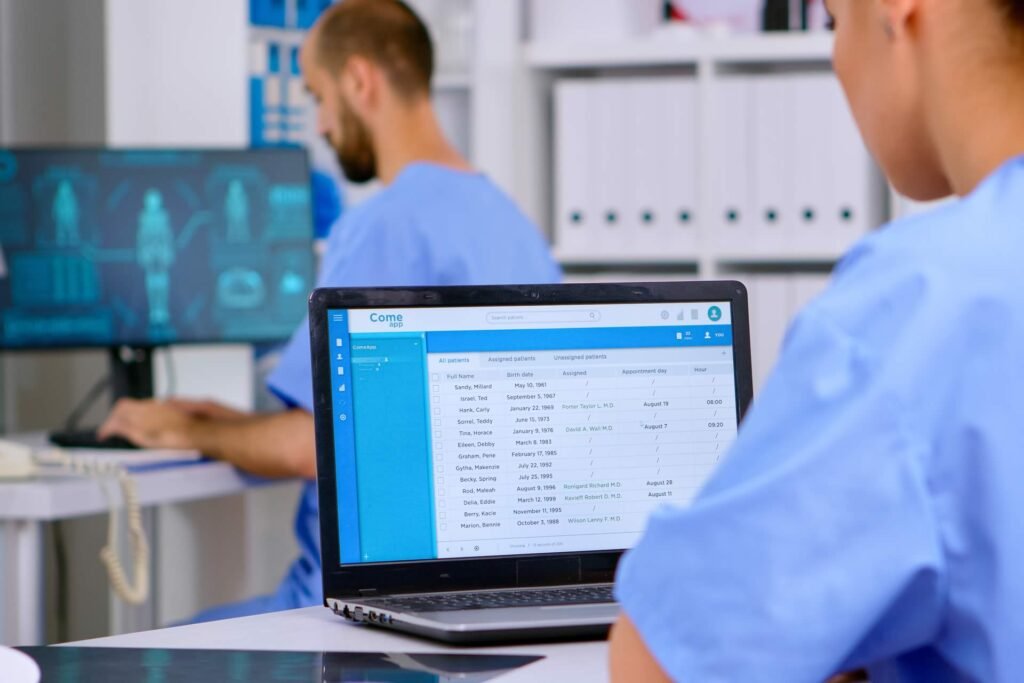
Electronic Health Records are essential yet often underutilized due to complexity and data overload. AI-powered EHR optimization is transforming how clinicians interact with patient data.
A collaboration between Cerner and the University of Missouri Health Care demonstrated how AI could automate documentation, identify anomalies, and generate actionable insights from structured and unstructured records.
- Automated data validation and error detection
- Predictive analytics for patient risk stratification
- Personalized care recommendations
- Improved clinician efficiency and satisfaction
By minimizing administrative friction, AI allows healthcare professionals to focus on clinical judgment rather than data management. This approach aligns with broader digital transformation strategies such as those enabled through AI development services.
AI in Digital Pathology

Digital pathology combines high-resolution imaging with AI-driven analysis to support accurate disease detection. Advanced algorithms now assist pathologists in identifying cancerous patterns across thousands of tissue samples with remarkable precision.
Recent research involving over 11,000 patient samples demonstrated AI’s ability to classify multiple cancer subtypes with accuracy rates exceeding 95%. These systems assist in identifying early-stage malignancies that may be missed during manual reviews.
- Automated tissue analysis and classification
- Early detection of rare pathologies
- Enhanced diagnostic consistency
- Decision support for complex cases
Digital pathology supported by AI accelerates diagnosis while improving diagnostic confidence across healthcare teams.
AI in Ophthalmology

Ophthalmology faces increasing demand due to aging populations and rising chronic eye conditions. AI-powered diagnostic tools now enable large-scale screening and early intervention.
FDA-approved systems for diabetic retinopathy detection analyze retinal images in under a minute with high sensitivity and specificity. Top AI companies in healthcare have developed similar AI models to assist in glaucoma detection and cataract progression monitoring through smartphone-based tools.
- Rapid screening in underserved areas
- Early detection of vision-threatening diseases
- Remote patient monitoring and follow-ups
- Reduced specialist workload
These advancements significantly improve access to eye care and reduce preventable vision loss.
Predictive Analytics for Better Patient Outcomes

Predictive analytics enables healthcare providers to anticipate patient risks before complications arise. By analyzing historical data, clinical records, and real-time inputs, AI models can forecast outcomes with high accuracy.
Collaborations such as those between Johns Hopkins and Microsoft Azure demonstrate how predictive analytics can reduce readmission rates and optimize resource allocation.
- Early identification of high-risk patients
- Personalized treatment planning
- Optimized hospital resource utilization
- Reduced emergency admissions
Predictive intelligence shifts healthcare from reactive to proactive care delivery.
AI for Chronic Disease Management
Chronic conditions require continuous monitoring and personalized care. AI-powered wearables and mobile health platforms now track vital signs, activity levels, and behavioral patterns in real time.
These systems provide actionable insights to both patients and clinicians, enabling timely interventions and reducing hospital visits.
- Continuous remote monitoring
- Early warning alerts for complications
- Improved patient engagement and adherence
- Lower long-term care costs
The integration of AI into chronic disease management has led to measurable improvements in quality of life and healthcare efficiency.
Personalized Medicine Through AI

Personalized medicine represents a paradigm shift from generalized treatment models to individualized care. AI enables this transition by analyzing genetic, clinical, and lifestyle data to guide therapeutic decisions.
Collaborations such as the Mayo Clinic and IBM Watson have demonstrated how AI can recommend optimized treatment pathways based on patient-specific insights, particularly in oncology.
- Precision treatment recommendations
- Reduced adverse drug reactions
- Improved treatment response rates
- Data-driven clinical confidence
As AI continues to mature, personalized medicine will become the standard rather than the exception.
The Future of AI in Healthcare
The next phase of use of AI in medical field will focus on deeper integration, interoperability, and scalability. Emerging use cases include intelligent revenue cycle management, AI-assisted drug discovery, automated clinical documentation, and predictive population health management.
Healthcare organizations will increasingly invest in workforce upskilling and infrastructure modernization to fully realize AI’s potential. As adoption grows, collaboration between clinicians, technologists, and policymakers will make the use of AI in medical field successful and transformative.
How Naga Info Solutions Can Help
As one of the top AI companies in healthcare, Naga Info Solutions enables healthcare organizations to design, build, and scale intelligent AI solutions tailored to real-world clinical challenges. From AI-powered diagnostics and automation to advanced data analytics and custom healthcare platforms, our teams deliver secure, scalable, and compliant systems.
Our expertise spans AI consulting, AI agent development, machine learning solutions, and AI-driven automation. We help healthcare organizations move from experimentation to real-world impact.
Whether you are modernizing clinical workflows or building next-generation healthcare platforms, our teams work as strategic partners to deliver measurable outcomes.
Frequently Asked Questions
Is AI reliable for medical decision - making ?
When trained on high-quality data and used alongside clinical expertise, AI enhances accuracy and supports better decision-making.
Can AI reduce healthcare operational cost ?
Yes. Automation, predictive analytics, and workflow optimization significantly reduce administrative overhead and inefficiencies.
How does AI improve patient outcomes ?
AI enables early detection, personalized treatments, and proactive care, leading to better health outcomes.
Is patient data secure in AI systems ?
Modern AI platforms follow strict compliance standards, encryption protocols, and data governance policies.
Can AI integrate with existing hospital systems ?
Yes. AI solutions are designed to integrate with EHRs, HIS, and other clinical systems seamlessly.
What are the limitations of AI in healthcare ?
AI depends on data quality, regulatory compliance, and human oversight to function effectively.
How long does it take to implement AI solutions ?
Implementation timelines vary based on complexity but typically range from weeks to months.
Is AI affordable for mid - sized healthcare providers ?
With cloud-based models and modular deployments, AI adoption is increasingly cost-effective.
What is the future of AI in healthcare ?
AI will continue to evolve toward predictive, personalized, and preventive healthcare models.
Conclusion
AI is no longer a futuristic concept, it is an operational reality reshaping healthcare delivery today. From diagnostics and personalized medicine to predictive analytics and automation, AI empowers healthcare organizations to deliver safer, faster, and more effective care.
As technology continues to evolve, organizations that invest in intelligent systems today will be best positioned to meet the demands of tomorrow. With the right strategy, expertise, and partners, AI technology in healthcare can unlock unprecedented value across the healthcare ecosystem.