


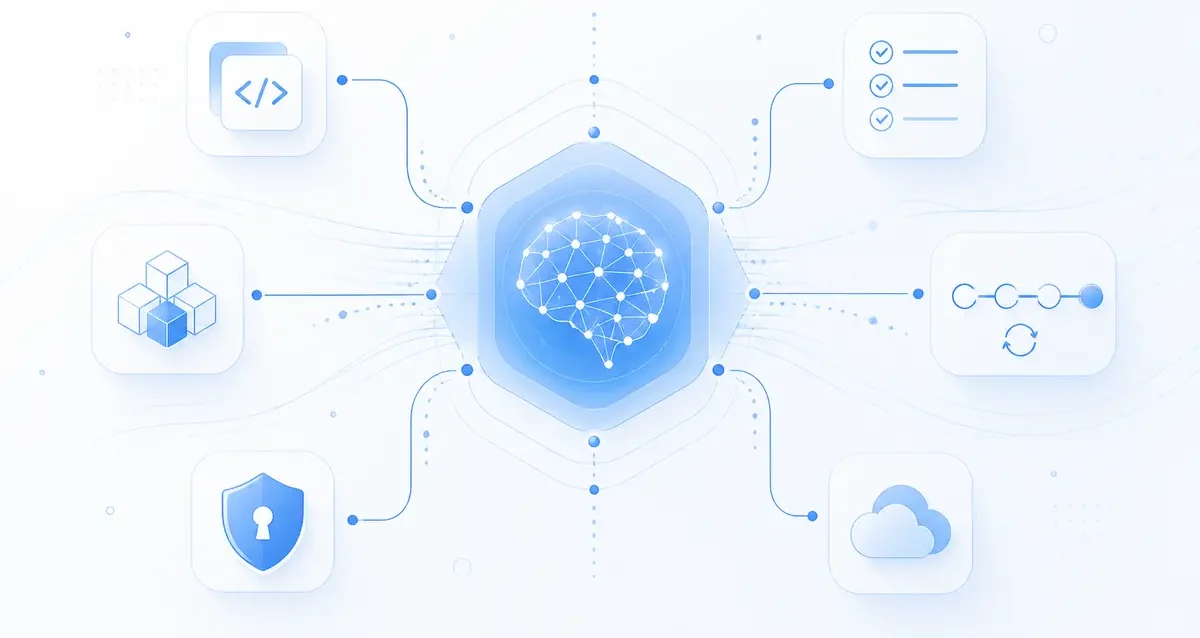
Why AI Matters for Software Development
AI in software development is reshaping the entire lifecycle—from requirements and design to coding, testing, deployment, and operations. It does more than autocomplete lines of code. Models can synthesize designs, suggest architectures, generate tests, triage incidents, and summarize logs so teams act faster with more confidence.
Scope of change:
- Code: context-aware suggestions, boilerplate generation, refactoring plans, docstrings, and migration helpers.
- Testing: unit and integration test synthesis, data generation, flaky test detection, and coverage guidance.
- Operations: anomaly detection, failure prediction, runbook generation, and change-impact insights.
- Design and product: requirement summaries, user-story expansion, API contract drafting, and sketch-to-code UI scaffolds.
Measurable benefits and common claims (and what to measure):
- Speed: faster first drafts and fewer context switches. Track time-to-first-PR, PR cycle time, and time-to-merge.
- Quality: earlier defect detection and clearer documentation. Track defect introduction rate, escaped defects, and code-review rework.
- Cost: fewer handoffs and better infrastructure efficiency. Track engineering hours per feature, cloud cost per request, and build minutes consumed.
- Reliability: quicker diagnosis and safer releases. Track incident mean time to detect and recover, and change failure rate.
Technological drivers:
- Models: large language models for code and text, small task-specific models for classification or ranking, and multimodal models for UI and diagram understanding.
- Compute: access to powerful accelerators for training and inference, plus optimization techniques that make on-premise or edge inference viable when privacy or latency matters.
- Data: code repositories, tests, telemetry, and domain knowledge that can be retrieved, fine-tuned, or grounded to keep outputs relevant.
- APIs and tooling: mature SDKs, embeddings, vector stores, and workflow automation that let teams wire AI into everyday tools and CI systems.
Who benefits most:
- Teams shipping frequent releases with large codebases or multi-service architectures where standardization and reuse compound.
- Organizations modernizing legacy systems that need migration aids, automated tests, and architecture guidance.
- Data-rich companies that can ground models in internal code, logs, and documentation for higher accuracy.
- Regulated or security-conscious companies that need private inference or strict access controls.
Short-term vs. long-term impacts:
- Short-term: autocomplete, doc generation, test scaffolding, queryable knowledge bases for code and ops. Success metrics: PR cycle time, code-review throughput, unit test coverage quality, and developer satisfaction.
- Long-term: AI-augmented architecture decisions, agentic workflows across CI/CD, broader platform automation, and talent model shifts. Success metrics: deployment frequency, change failure rate, MTTR, infra cost per transaction, and time-to-onboard new engineers.
Where helpful, Naga Info Solutions supports organizations with AI consulting to identify high-impact use cases and with AI development to implement grounded models, private inference, and workflow automation that fit security and compliance needs.
AI-Powered Tools and Platforms
AI software development tools fall into clear categories that map to day-to-day work. Understanding how they integrate and how to evaluate them prevents costly false starts.
Core categories and typical use cases:
- Code generation and IDE assistants: inline suggestions, function and test stubs, refactoring proposals, comments-to-code, and migration hints. Useful for accelerating routine tasks and raising consistency across teams.
- Automated testing: unit/integration test creation, data and mock generation, API contract test scaffolding, UI test script synthesis, and mutation-testing helpers to gauge assertion strength.
- Security scanners: secret detection, insecure pattern recognition, dependency risk summarization, and remediation suggestions grounded in the current codebase.
- Observability and DevOps AI: anomaly detection on metrics, log clustering and summarization, incident impact estimation, and release risk scoring.
Common integration patterns:
- IDE/browser extensions: quick adoption, immediate feedback loops, and per-developer customization.
- APIs and SDKs: integrate AI into internal tools, CLIs, and services; ideal for custom prompts, retrieval, and policy enforcement.
- Platform plugins: CI/CD, code hosts, ticketing, and chat systems; centralize governance and auditing.
- Hosted services: managed infrastructure and frequent updates, often with enterprise controls and SSO.
Vendor evaluation checklist:
- Accuracy and reliability: context handling, testable output, rate of security or logic issues.
- Privacy and data handling: data retention policies, ability to disable training on your data, encryption in transit/at rest, regional hosting.
- Latency and throughput: interactive responsiveness in IDEs and predictable performance in CI.
- Auditability and controls: prompt/output logging, role-based access, redaction, and policy enforcement.
- Customization: support for retrieval over your repositories, fine-tuning or adapters, and model choice.
- Operability: versioning, change logs, rollback options, and support SLAs.
- Total cost of ownership: licenses, inference costs, integration effort, and ongoing maintenance.
Deployment options and trade-offs:
- Public model APIs: fastest start, broad capabilities, and regular updates. Trade-offs include data-sharing considerations and variable latency.
- Private fine-tuned models: higher relevance with your code and terminology. Requires curation of training data, evaluation pipelines, and MLOps maturity.
- On-premise or VPC inference: maximum control and data privacy with predictable performance. Demands infrastructure, model optimization, and lifecycle management.
- Hybrid: route workloads by sensitivity and latency; for example, public models for low-risk tasks and private inference for proprietary code.
Naga Info Solutions helps teams compare deployment options, design retrieval strategies to ground outputs in internal repositories, and integrate assistants into IDEs, CI/CD, and workflow automation. Our AI consulting and AI development services focus on accuracy, privacy, and maintainability—so tools enhance, rather than complicate, your stack.
How AI Changes Coding and Architecture
AI-assisted programming reshapes how developers plan, write, and review code. The technology is most effective when it’s embedded into deliberate workflows rather than used ad hoc.
Productive coding patterns:
- Autocomplete with intent: provide concise comments describing the next small unit of work, accept short suggestions, then run tests. This reduces large, brittle insertions and surfaces errors earlier.
- Sketch-to-code: start with a high-level description, pseudo-code, or UI wireframe. Ask the assistant for a minimal scaffold and acceptance tests, then iterate. This suits new modules, APIs, or front-end components.
- Pair programming with an assistant: alternate between “Builder” (generate code) and “Critic” (explain risks, edge cases, and alternatives). Capturing both outputs in the PR description improves reviews.
Influence on architecture and design:
- Option exploration: query the model for 2–3 architecture options given non-functional requirements (throughput, latency, compliance), then ask for trade-off tables and risk lists. Use this to broaden thinking, not to outsource decisions.
- Interface-first development: generate interface contracts, data models, and example payloads before implementation. This encourages separation of concerns and testability.
- Migration planning: request dependency graphs and stepwise refactoring plans for modularization; validate each step with tests before continuing.
Managing code quality with AI:
- Linting and refactoring: assistants can surface anti-patterns, propose smaller functions, or suggest more efficient queries. Require explanations and diffs for clarity.
- Technical debt detection: ask for hotspots by combining commit history, code complexity, and low test coverage. Prioritize by usage and risk.
- Documentation as code: generate docstrings and design notes alongside implementation to reduce drift and help onboarding.
Common failure modes and mitigations:
- Hallucinations and brittle suggestions: constrain tasks (“implement only this function”), paste relevant code context, and require runnable examples. Keep temperature low for deterministic results.
- Subtle logical errors: insist on generated unit tests and property-based checks; run static analysis and security scans on AI-generated diffs.
- Outdated or generic patterns: ground prompts with your framework versions, coding standards, and architecture principles.
Prompt guidelines that improve reproducibility:
- Provide role, objective, and constraints: “You are a senior backend engineer. Goal: implement pagination for endpoint X. Constraints: framework version Y, data model Z, return only code for function handlePage().”
- Supply context windows: include relevant files, interfaces, and error messages; reference internal patterns by name.
- Ask for tests and reasoning: “Propose 3 edge cases and generate tests covering them.” Store prompts with the code review for traceability.
- Standardize templates: keep a small library of prompt patterns for common tasks (API handlers, data mappers, UI components). Version them and pin model settings.
Naga Info Solutions can help teams establish prompt libraries, retrieval over internal repos for accurate context, and governance so AI output consistently meets your coding standards.
Testing, QA, and Reliability with AI
Testing is where AI creates immediate, verifiable impact when it’s tied to strong validation practices.
Automated generation techniques:
- Unit tests: generate tests from function signatures, docstrings, and examples; request boundary, null, and error-path cases explicitly.
- Integration tests: derive scenarios from API contracts and message schemas; ask the assistant to propose mocks, fakes, and seed data.
- Property-based and fuzz testing: specify invariants (e.g., idempotency, monotonicity) and have the model enumerate inputs; combine with generative fuzzers for broader coverage.
- UI tests: convert acceptance criteria into user flows and selectors; keep locators resilient by favoring semantic hooks over brittle DOM paths.
Prioritization, flakiness, and root cause analysis:
- Test prioritization: use change-impact analysis—map modified files to affected test suites; layer in historical failure data to rank by risk.
- Flaky test detection: classify failures by signal patterns (timing, order dependency, resource contention) and quarantine suspects while auto-generating stabilization suggestions.
- Root cause prediction: correlate failing tests, recent commits, and logs; summarize likely culprit modules and relevant diffs to speed triage.
Enhancing observability with AI:
- Anomaly detection: learn typical metric and log patterns, flag deviations, and estimate blast radius by linking to recent deployments.
- Log summarization: cluster similar errors, extract key stack traces, and produce plain-language briefs suitable for incident channels and post-PR checks.
Validation strategies to avoid false confidence:
- Review and mutate: pair AI-generated tests with mutation testing to measure assertion strength; discard tests that pass weak mutants.
- Coverage quality, not just quantity: require branch/condition coverage targets for critical modules and track assertion density.
- Differential testing: compare outputs across old and new implementations; useful for refactors and migrations suggested by assistants.
- Quarantine and prove: run new AI-generated tests in quarantine for several cycles; promote only those with stable signal and meaningful failures.
- Human-in-the-loop on critical paths: mandate reviewer approval for security, payments, or safety-related tests.
- Telemetry feedback: record which AI-generated tests catch real regressions; use this data to refine prompts and templates.
Naga Info Solutions helps teams wire these practices into pipelines—generating targeted tests, ranking suites by risk, and connecting AI-driven insights to CI gates and incident workflows—so reliability improves alongside velocity without inflating noise.
DevOps, CI/CD, and Observability
AI in software development doesn’t stop at code and tests; it reshapes how software moves to production and how systems are kept healthy. The practical value shows up in faster, safer releases and fewer late-night incidents.
AI-driven pipeline optimization and release risk scoring
- Intelligent risk scoring: Models assess signals such as code churn, ownership patterns, dependency changes, historical test failures, test coverage gaps, and incident history to estimate release risk. Teams can use scores to gate promotions, trigger extra test suites, or require canary deploys before full rollout.
- Dynamic pipeline optimization: ML predicts the smallest set of tests likely to catch regressions (test-impact analysis), prioritizes long-running or flaky suites, and tunes parallelization and caching automatically. Over time, pipelines shrink without sacrificing coverage because they learn which steps provide the most signal per minute.
Automated rollback and remediation using predictive alerts
- Predictive detection: Models watch leading indicators—subtle latency shifts, rising error rates in a specific endpoint, or anomalies in user behavior—and flag potential regressions minutes before SLOs breach.
- Policy-driven actions: When risk crosses a threshold, the system can flip feature flags, roll back the last deployment, or apply known remediations (restart a service, revert a config) while notifying on-call. Keep a human-in-the-loop for irreversible actions and always log the decision path.
Resource and cost optimization for cloud infrastructure
- Rightsizing and autoscaling: ML recommends instance sizes, container limits, and autoscaling thresholds based on workload patterns, preventing both waste and throttling.
- Forecasting and scheduling: Capacity forecasts align non-urgent jobs (batch ETL, training runs) with off-peak periods to lower costs.
- Cost anomaly detection: Models flag sudden spend spikes by service, region, or tag and suggest likely culprits such as runaway queries or misconfigured storage.
AI-assisted incident triage, runbook generation, and postmortems
- Faster triage: Language models summarize noisy alert storms into a single incident narrative, cluster related alerts, propose severity, and route to the most likely owning team based on past resolution data.
- Actionable guidance: Runbooks can be generated or updated automatically from prior incidents, wiki pages, and architecture docs—presented as step-by-step checks during an incident.
- Better postmortems: After resolution, AI compiles a timeline from commits, deploy logs, chat, and monitoring data; identifies common failure factors; and suggests preventive tasks for the backlog.
Best practices for integrating AI into existing CI/CD pipelines
- Start advisory-only: Run models in “shadow” mode to score risk and recommend optimizations before they’re allowed to act.
- Gate with policies: Tie high-risk scores to canary deploys, expanded tests, or manual approvals. Keep clear escalation paths.
- Version and audit everything: Treat prompts, model versions, and AI policies as code. Store explanations from AI actions in immutable logs.
- Contain blast radius: Use feature flags and staged rollouts. Automate rollbacks but require human confirmation for database migrations or stateful changes.
- Validate continuously: Compare AI-driven test selection and pipeline changes against a full run periodically to ensure no coverage drift.
- Secure integration: Restrict model access to build artifacts and redacted logs only. Scan outputs for secrets before storage.
Where it helps to move quickly and safely, Naga Info Solutions integrates AI into CI/CD and observability—designing model-driven risk gates, automating runbooks with agentic workflows, and using workflow automation to orchestrate rollbacks and remediations while preserving auditability and human oversight.
Impact on Teams, Roles, and Processes
AI-assisted programming changes daily work patterns more than job descriptions. Teams still own quality and outcomes; they just collaborate with new tools.
How day-to-day workflows change
- Coding: Developers use IDE assistants for structured prompts, inline suggestions, and quick refactors. They ask for design alternatives, complexity estimates, and edge-case checks as they type.
- Reviews: Reviewers receive summarized diffs, potential risk areas, and suggested tests. Authors include a short “intent” note (sometimes AI-drafted) so reviewers evaluate outcomes, not just syntax.
- Documentation and knowledge: Teams auto-generate API docs, change logs, and examples from code and tests. Internal chat agents answer “where is this used?” based on repositories and tickets.
- Coordination: Standups and PR queues are summarized automatically with next-step suggestions, helping leads focus on decisions rather than status gathering.
Evolving roles
- Prompt engineers: Define prompt templates, system messages, and safety constraints for common engineering tasks. They collaborate with platform teams to standardize usage.
- ML-for-code specialists: Fine-tune or adapt models for your stack, own evaluation datasets, and measure accuracy on internal coding tasks.
- AI tool maintainers: Operate the platform—model versioning, latency/SLA targets, cost controls, and telemetry. They ensure updates don’t degrade developer experience.
- Data and security stewards: Govern what code and data can be sent to models and enforce redaction, access, and retention policies.
Process changes to ensure quality
- Update code review policies: Require authors to mark AI-assisted segments and include a verification note (reasoning steps, test scope, and trade-offs considered).
- Add AI-output checks: Enforce unit and property tests for AI-generated logic. Treat security-related code as “high scrutiny” with mandatory pair review.
- Control data flow: Prohibit secrets and sensitive identifiers in prompts. Gate external model access behind proxies that redact and log.
- Maintain evaluation suites: Keep a living benchmark of representative tasks to validate tools before upgrades.
Upskilling and hiring strategies
- Core skills: Structured prompting, reading and validating AI reasoning, test-first thinking, privacy basics, and an understanding of model limitations.
- Training plan: Short, scenario-based workshops; pair sessions where seniors demonstrate safe patterns; and playbooks that map common tasks to prompt templates.
- Hiring: Look for product-minded engineers who can question outputs and build evaluation harnesses—not just power users of AI software development tools.
Culture and collaboration shifts
- Calibrated trust: Default to “trust but verify.” Reward thoughtful validation and the courage to delete weak AI-generated code.
- Ownership: Humans remain accountable for outcomes. Make this explicit in PR templates and incident reviews.
- Feedback loops: Instrument usage and collect qualitative feedback so the platform team can retire failing patterns and scale the ones that work.
Naga Info Solutions supports the organizational side of AI adoption with AI consulting, training, and process design—helping you define policies, evaluation practices, and the operating model for sustainable, safe productivity gains.
Security, Privacy, and Legal Considerations
AI in software development introduces new risk surfaces alongside familiar ones. Address them systematically to protect IP, customers, and your reputation.
Key risks to manage
- IP leakage: Proprietary code, credentials, or architectural details can end up in prompts or logs. Public models may learn from user inputs depending on provider settings.
- Training data exposure: Generated code may resemble licensed or restricted material if the underlying model was trained on it.
- Supply-chain vulnerabilities: AI can recommend insecure dependencies, generate scripts with dangerous defaults, or accept malicious content via prompt injection.
Privacy and compliance when using third-party models
- Data transfer and residency: Understand what data leaves your environment, which regions it traverses, and where it’s stored. Ensure vendor terms reflect your obligations.
- Logging and retention: Confirm whether prompts and outputs are stored, for how long, and who can access them. Prefer no-retention modes for sensitive contexts.
- Access control: Enforce role-based permissions and use service accounts, not personal tokens, for production pipelines.
Mitigation tactics
- Data minimization: Redact secrets, PII, and unique identifiers. Use synthetic or masked samples when possible.
- Private or on-prem models: For high-sensitivity code and data, consider self-hosted or privately fine-tuned models with strict network controls.
- Policy-based routing: Send low-risk prompts to hosted models and high-risk ones to private endpoints. Log routing decisions.
- Guardrails and scanning: Add pre-prompt secret scanning, output linting for insecure patterns, and dependency allowlists.
- Least privilege: Limit model access to only the repositories or logs required for the task, with encryption in transit and at rest.
Licensing and copyright for AI-generated code
- Provenance tracking: Tag AI-assisted code in commits and maintain references to prompts and sources used.
- License compatibility: Scan outputs and dependencies for copyleft or conflicting licenses. Require human review before adopting generated code that mirrors known implementations.
- Internal fine-tunes: Keep a record of datasets used to adapt private models to support future audits.
Auditing and accountability
- Evidence trails: Store prompts, model versions, outputs, reviewer approvals, and deployment metadata.
- Model risk reviews: Periodically evaluate new model versions for regressions, security patterns, and data handling changes.
- Incident response: Prepare playbooks for prompt injection, data leakage, and compromised model endpoints.
Naga Info Solutions can help design secure architectures for AI-assisted development—deploying private inference where needed, implementing access controls and redaction pipelines, and integrating provenance tracking without disrupting developer flow. For specific legal obligations, coordinate with internal counsel.
Best Practices for Safe AI Adoption
A disciplined rollout multiplies value and limits downside. Treat AI capabilities as product features in your engineering platform.
Start with targeted pilot projects and measurable hypotheses
- Choose high-signal use cases: test authoring, refactoring suggestions, or triage summaries.
- Define hypotheses and metrics: for example, “Cut PR review time by 20% while holding defect rate constant.”
- Run time-boxed pilots: 6–8 weeks with clear baselines and a control group where possible.
Establish guardrails
- Data policies: What can and cannot be shared with models. Enforce through proxy services that redact and log.
- Human-in-the-loop: Require human approval for high-risk actions (security-sensitive code, production rollbacks, schema changes).
- Approval workflows: Change requests for new prompts, model upgrades, or new repositories added to AI assistance.
- Kill switch: Ability to disable a model or feature quickly if behavior degrades.
Create standards
- Prompt templates: Curated, versioned prompts for common tasks with examples and anti-patterns.
- Code-review rules: Mandatory tests for AI-generated logic, documentation of assumptions, and explicit ownership.
- Security baselines: Secret scanning before prompts, output scanning for insecure patterns, and dependency allowlists.
- Documentation: A living playbook with accepted use cases, model versions, and evaluation results.
Implement monitoring
- Quality metrics: Cycle time, time-to-merge, escape defect rate, and rework on AI-assisted code.
- Detection: Hallucination flags, insecure pattern detection, and drift alerts when model suggestions worsen.
- Usage and cost: Per-team usage, latency, and spending caps with alerts.
- Shadow evaluation: Periodic runs of synthetic prompt suites to catch regressions after model updates.
Plan rollout
- Training: Short, hands-on sessions and office hours. Publish internal “recipes” that map tasks to prompt templates.
- Phased expansion: Start with one repo or team, then expand by risk tier. Include rollback criteria tied to quality or incident thresholds.
- Ownership: Assign a platform owner for AI capabilities with clear SLAs, upgrade cadence, and vendor review cycles.
Naga Info Solutions supports safe adoption with AI prototyping to validate use cases quickly, AI consulting to set guardrails and standards, and automation expertise to integrate models into your toolchain without sacrificing control.
Measuring ROI and Productivity
AI in software development only pays off when results are measured with discipline. Treat evaluation as an engineering task with clear metrics, controlled experiments, and transparent reporting.
Define KPIs across speed, quality, reliability, cost, and developer experience:
- Speed and flow: lead time for changes (from work start to production), cycle time (PR open to merge), time-to-merge, deployment frequency.
- Quality: pre-merge defect discovery rate, escaped defects per release, hotfix count, code review rework rate (review rounds or change requests), change failure rate.
- Reliability: mean time to recovery (MTTR), incident volume by severity, flaky test rate.
- Cost and efficiency: compute cost per environment/service, build minutes per change, test execution time, cloud waste identified and removed.
- Developer experience: suggestion acceptance rate, editing distance from AI suggestion to merged code, tool abandon rate, survey-based indicators (clarity, trust, perceived time saved).
Establish baselines and run fair tests:
- Time-series baseline: capture 4–6 weeks of pre-adoption metrics, introduce a 1–2 week ramp, then measure for 6–8 weeks post-adoption. Watch for seasonality, release freezes, or staffing changes.
- A/B or stepped-wedge: roll out to subsets of teams in phases. Keep work type comparable (e.g., similar services or backlogs) to avoid bias.
- Within-developer randomization: assign comparable tasks with and without AI assistance for the same engineer to control for skill differences.
- Outcome-centric telemetry: track acceptance rate of suggestions, test pass rate for AI-generated tests, defect density in AI-touched code, and revert frequency. Favor post-merge outcomes over offline benchmarks.
Map qualitative feedback to hard signals:
- If developers report higher cognitive load, examine PR churn and time-to-merge for increases.
- If trust is low, correlate with low acceptance rates and high abandon rates; investigate prompt patterns and tool latency.
- If AI is helpful on boilerplate but not domain logic, split metrics by file type or layer to target improvements.
Use a simple cost-benefit template:
- Costs (monthly): licenses and usage fees, model hosting or infrastructure for private inference, engineering time for integration and governance, security and compliance overhead, training time.
- Benefits (monthly): value of time saved (hours saved per developer per week × loaded hourly rate × developer count × weeks), quality gains (avoided defect cost × defects avoided), infrastructure savings (reduced build/test/cloud spend), revenue acceleration if faster delivery is material to the business.
- Net ROI (%) = ((Value of time saved + Quality impact + Infra savings + Revenue impact) − Total cost) ÷ Total cost.
- Break-even time saved per developer per week = Total monthly cost ÷ (loaded hourly rate × developer count × 4.3).
Build a practical dashboard and cadence:
- Core widgets: lead time distribution, time-to-merge trend, change failure rate, MTTR, AI suggestion acceptance and edit distance, defect discovery pre/post merge, cost per build/test, usage by team.
- Guardrail panels: PII leakage incidents prevented, hallucination flags in code review, flaky test detection trends.
- Reviews: weekly operational review for teams, monthly steering meeting for leaders, quarterly tool re-evaluation with keep/scale/retire decisions.
Common pitfalls to avoid:
- Measuring only speed: balance with quality and reliability or you risk faster but riskier releases.
- Ignoring ramp time: productivity may dip while teams learn new workflows.
- Conflating correlation with causation: use controls and document confounders (new architecture, peak season, hiring changes).
Where helpful, Naga Info Solutions can assist with end-to-end measurement: instrumenting CI/CD and IDE telemetry, designing fair A/B evaluations, building data pipelines and dashboards, and quantifying cost-benefit for private vs hosted models through our AI Consulting and AI Automation services.
Future Trends and How to Prepare
Emerging capabilities are expanding what teams can delegate to machines and where humans should focus judgment and creativity.
- Program synthesis: moving from line-by-line suggestions to generating cohesive modules and services from high-level specs and tests. Expect tighter integration with properties and constraints so models can propose code plus validation scaffolding.
- Multimodal coding: turning sketches, UI mocks, logs, APIs, and voice instructions into code and tests. Designers and product managers will be able to provide artifacts that translate directly into working components under developer oversight.
- Self-driving CI: pipelines that adapt automatically—selecting tests, provisioning ephemeral environments, opening PRs to fix builds, and risk-scoring releases with rollback plans pre-baked. Human owners audit and approve; agents do the toil.
- Agentic workflows: specialized AI agents triage issues, draft runbooks, propose refactors to reduce technical debt, and keep dependencies current, while coordination agents schedule work to minimize risk across services.
Organizational strategies for continuous learning and governance:
- Establish a model and prompt lifecycle: version prompts, keep an internal prompt catalog, and test changes with regression suites before rollout.
- Create an evaluation harness: use representative repos and scenarios (new feature, bug fix, refactor) with pass/fail criteria tied to your KPIs.
- Govern data flows: define what code and logs can be sent to third-party models, retain redaction by default, and use private inference for sensitive workloads.
- Red-team periodically: probe for insecure code patterns, leakage risks, and hallucination-prone prompts; feed findings into standards and training.
- Keep humans in the loop: approvals for high-risk changes, graduated autonomy for agents based on past performance, and clear escalation paths.
Ethical and societal considerations to monitor:
- Workforce impact: invest in reskilling and make progress visible; align performance expectations with augmented workflows, not raw output volume.
- Bias and safety: require secure-by-default patterns and accessibility checks in generated code; monitor for insecure suggestions.
- Environmental impact: prefer efficient inference, cache results, and schedule heavy jobs off-peak to reduce waste.
- IP provenance: trace AI contributions, record prompts and outputs, and respect license boundaries with policy and tooling.
A pragmatic five-year roadmap template:
- Year 1: Pilot coding assistants and AI-generated tests in a few teams; instrument baselines; define policies for sensitive data and reviews; document prompt patterns that work.
- Year 2: Extend to CI optimization, test selection, and observability summarization; deploy private or fine-tuned models for sensitive code; formalize governance and training.
- Year 3: Introduce agents for incident triage, dependency updates, and documentation; integrate retrieval over internal code and architecture docs; begin property-based testing where quality is critical.
- Year 4: Adopt multimodal design-to-code for front-end and APIs; move toward self-adapting pipelines with risk scoring; optimize compute and caching strategies.
- Year 5: Allow controlled autonomous changes in low-risk domains with human approvals; standardize maturity metrics; continuously re-evaluate build-vs-buy and model choices.
Suggested learning paths:
- Developers: prompt engineering for coding tasks, critical reading of model output, secure coding with AI assistance, test design to validate AI-generated code.
- Tech leads and architects: pattern libraries for AI-assisted design, governance and risk controls, cost/performance tuning for model usage.
- Platform and MLOps: model serving, evaluation suites, usage metering, incident response for AI components.
- Executives: ROI frameworks, procurement criteria, capability roadmaps, and change management.
Naga Info Solutions helps organizations operationalize this roadmap: from AI Consulting to define governance and a capability portfolio, to AI Development and AI Agent Development to build private, auditable assistants and agentic workflows aligned with your systems and controls.
Frequently Asked Questions
Accuracy varies by language, domain complexity, and how well you scope the task. Models are strong on idiomatic patterns and boilerplate, and weaker on novel business logic without clear context. Measure practical accuracy by acceptance rate, post-merge defect rate, and the edit distance between suggestions and final code. Pair AI-generated code with solid tests and reviews.
It changes the work. AI-assisted programming automates repetitive code and helps explore options faster, while developers focus on design, integration, edge cases, security, and validation. New responsibilities emerge around prompt design, evaluation, and governance. Human oversight remains essential for quality and accountability.
Adopt clear policies, technical controls, and training. Do not paste secrets or customer data into prompts; use automated secret scanning in repos and terminals; prefer private or on-premise inference for sensitive code; redact logs and data by default; enforce access controls and logging for model usage; and complete vendor privacy and data-processing reviews before adoption.
Common high-yield areas include coding assistance, test generation and prioritization, CI optimization and flaky test detection, observability and incident summarization, security scanning, and documentation. Choose repetitive, high-volume workflows first and validate value with your KPIs.
Run time-bound pilots with explicit success criteria, compare against a baseline or control group, and review security, privacy, latency, total cost of ownership, auditability, and deployment options (hosted vs private). Ensure integration with your IDEs, repositories, and CI/CD, and verify vendor support and roadmap fit.
Clear task scoping and prompt writing, critical evaluation of model output, strong test design, secure coding with AI, data hygiene and privacy awareness, and familiarity with versioning prompts and templates. Understanding common AI failure modes helps developers steer models productively.
Define a balanced KPI set (speed, quality, reliability, cost, and developer experience), capture a pre-adoption baseline, and use A/B or phased rollouts. Calculate ROI with a simple model: value of time saved plus quality and infra savings minus total cost. Track dashboards weekly, review outcomes monthly, and reassess tools quarterly based on evidence.