

Quick answer and recommendation
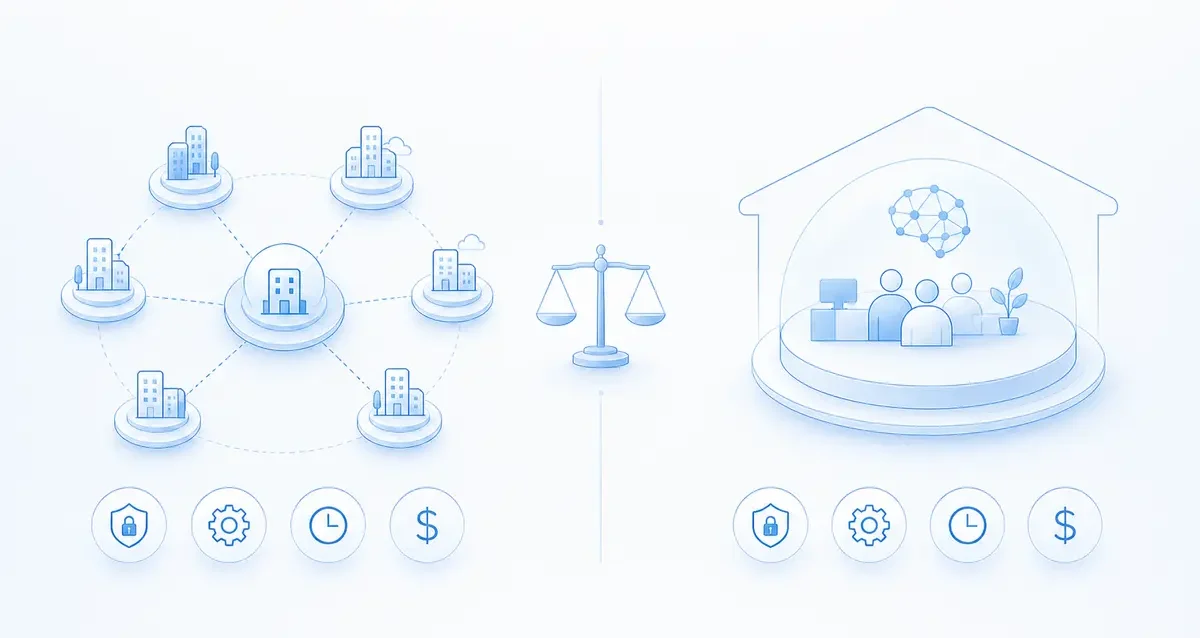
If you need a working solution fast, have limited AI hiring capacity, or want to de-risk a new idea, an experienced AI development company will usually win. If AI is core to your product moat and you can invest in long-term capability, building an in-house AI team pays off.
- Startup: Favor a vendor to validate your use case within 60–120 days, then consider insourcing selectively once you see traction.
- SMB: Use a hybrid approach—outsource the build, keep data access, product ownership, and basic MLOps internally.
- Enterprise: If AI touches core IP or sensitive data, build a small internal core team and augment with a vendor for speed and specialized skills.
Top scenarios that favor an AI development company:
- You need an MVP or pilot in weeks, not quarters, and lack internal AI expertise.
- Your scope demands niche skills (e.g., RAG, voice agents, computer vision, or MLOps at scale).
- You want elastic capacity to handle spikes without permanent headcount.
Top scenarios that favor building an in-house AI team:
- AI is central to your product strategy and competitive advantage.
- You operate under strict security/compliance constraints and require deep control.
- You need sustained iteration on proprietary data/models beyond an initial rollout.
Rule of thumb: If the goal is validation and speed, start with a vendor; if the goal is long-term differentiation on proprietary data, build internal capability.
Naga Info Solutions can work either way—owning delivery for pilots and co-developing with your team as you scale capability.
What each option actually means
AI development company
An AI development company provides end-to-end or specialized services to design, build, and operate AI solutions. Typical service models include:
- Agency/consultancy: Cross-functional teams that handle discovery, modeling, engineering, and delivery with a defined scope and milestones.
- Boutique specialist: Deep expertise in a narrow area (e.g., voice agents, computer vision) for high-stakes or complex problems.
- Offshore/nearshore delivery: Cost-effective, larger teams with follow-the-sun coverage; requires strong process and communication to maintain quality.
- Managed service: Ongoing ownership of operations (monitoring, model retraining, incident response) under SLAs, often after an initial build.
Deliverables and contracts commonly include statements of work (SOWs), acceptance criteria, IP and data-processing terms, security obligations, and SLAs for support. Commercial models are usually fixed-price for well-defined scopes, time-and-materials for evolving work, or retainers for ongoing operations.
In-house AI team
An internal team is a permanent capability inside your organization. Common roles include:
- Product management for AI: Prioritizes use cases, scope, success metrics, and user experience.
- Data engineer: Builds and maintains data pipelines, quality checks, and feature stores.
- ML/AI engineer: Trains/fine-tunes models, designs prompts and RAG pipelines, and ships inference services.
- MLOps engineer: Owns CI/CD for models, model registry, monitoring, retraining workflows, and cost controls.
Depending on the product, you may also need full-stack engineers, QA/automation, analytics, domain SMEs, and security. Employment relationships emphasize cultural fit, performance management, and retention; ramp-up involves recruiting, onboarding, and internal process setup.
Hybrid, co-development, and managed-plus-oversight
Many organizations blend both approaches:
- Co-development: A vendor works side-by-side with your team, pairing on code, IaC, and MLOps so knowledge stays internal.
- Staff augmentation: Vendor engineers embed with your squads under your processes and tooling.
- Managed-services plus internal oversight: The vendor runs day-to-day models and pipelines while your internal team sets standards, approves changes, and owns roadmap decisions.
Naga Info Solutions supports pure outsourcing, co-development, and managed AI operations. Engagements typically include architecture docs, model cards, runbooks, and handover plans so your team can own or extend the solution later.
Key decision criteria to evaluate
Use these factors to compare an AI development company vs in-house AI team:
- Cost: Compare vendor day rates or retainers against fully loaded employee costs (salary, benefits, tools, management overhead). Include cloud and data costs in both cases.
- Time-to-market: Vendors can start fast using existing frameworks and playbooks. In-house requires recruiting and ramping but may accelerate after initial setup.
- Control and IP: In-house offers maximum control over code, models, and roadmaps. Vendors can contractually assign IP, but you must enforce open handoff and avoid hidden dependencies.
- Security and compliance: Sensitive data, strict policies, or audit requirements often push toward internal control or carefully vetted vendors with strong controls.
- Domain expertise: Vendors bring pattern knowledge from many projects; internal teams develop deep context over time. Pick the mix that gives you both when stakes are high.
- Scalability and elasticity: Vendors scale teams up/down quickly. Internal scaling depends on hiring velocity and leadership bandwidth.
- Strategic fit: If AI is core to your moat, in-house ownership matters. If it’s enabling but not differentiating, outsourcing is often efficient.
How weightings differ by stage and industry
- Early-stage startup: Heavily weight time-to-market and cost; deprioritize long-term control until product/market fit is clearer.
- SMB: Balance cost, speed, and maintainability; ensure at least light internal ownership of data and MLOps.
- Enterprise/regulated: Weight security/compliance, integration with enterprise systems, and IP control; use vendors for specialized builds under strict guardrails.
Tradeoffs between speed and control (examples)
- Need a demo in 8 weeks to validate demand: Speed outranks deep control—use a vendor under a short SOW with explicit handover.
- Building a proprietary recommendation engine central to your product: Control outranks speed—staff key roles in-house, use a vendor for targeted components (e.g., MLOps hardening).
- Multiple bets across business units: Speed plus elasticity—vendors handle parallel pilots; internal platform team standardizes governance and data.
Map project goals to decision criteria
- Define the goal: e.g., “Launch a support deflection agent with 30% ticket reduction within 90 days.”
- Identify constraints: compliance, data locality, budget ceiling, integration complexity.
- Assign weights: e.g., time-to-market (35%), cost (25%), security (20%), maintainability (20%).
- Score options: Vendor vs in-house on each factor using a 1–5 scale; document assumptions and risks.
- Decide the delivery model: Full outsource, hybrid co-dev, or in-house-first with targeted vendor help.
Naga Info Solutions can facilitate a short decision workshop to align stakeholders on weights, risks, and delivery model before you commit budget.
Cost comparison and total cost of ownership
Think in terms of total cost of ownership (TCO): build, operate, and evolve over time. Compare both upfront and recurring costs for an AI development company vs in-house AI team.
Upfront costs
- Vendor: Discovery, architecture, data assessment, and initial build. You pay setup plus the first milestone/retainer. Little to no recruiting cost.
- In-house: Recruiting fees and time, onboarding, foundational tooling and environments, initial process creation (security reviews, SDLC, MLOps).
Recurring costs
- Vendor: Ongoing sprints or managed-service retainer, change requests, monitoring and retraining SLAs.
- In-house: Salaries and benefits across roles, management overhead, training, attrition backfill, and continuous platform upkeep.
Shared infrastructure, cloud, and tooling expenses
- Compute and storage: Training/fine-tuning GPUs or CPU/GPU inference clusters; object storage for datasets and embeddings.
- Data pipelines and integration: ETL/ELT services, feature stores, connectors, and data quality tooling.
- MLOps and observability: Model registry, experiment tracking, CI/CD, monitoring (latency, accuracy, drift), alerting, and logging.
- Security and governance: Access controls, secrets management, encryption at rest/in transit, audit logging, and periodic assessments.
- Model and data labeling: Human-in-the-loop review, annotation tools, and evaluation harnesses.
Hidden costs to surface in plans
- Integration and change management with adjacent systems and teams.
- Vendor management and procurement cycles; or, for in-house, people-management bandwidth.
- Knowledge transfer: Documentation, shadowing, and training to avoid single points of failure.
- Turnover risk: Rehiring and ramp time internally; dependency risk externally if you lack handover.
Simple cost scenarios/templates
Short-term pilot (8–12 weeks):
Vendor: Estimate as blended rate × team size × weeks + fixed setup. Optimize by narrowing scope to the minimum viable workflow and prebuilt components.
In-house: Hiring delay often exceeds pilot duration. If you must insource, consider contractors or a co-dev model to avoid idle time while recruiting.
Long-term product ownership (12–24 months):
Vendor: Combine initial build + monthly run/maintain. Add change-budget for new features. Ensure you own code, infra, and pipelines to keep switching costs low.
In-house: Sum fully loaded costs for a small pod (e.g., product, ML, data, MLOps, and part-time security/QA) + cloud + tooling. Expect productivity gains as the team learns your domain.
Break-even timeline and ROI approach
Break-even: Solve for t where cumulative in-house cost equals cumulative vendor cost.
Cinhouse(t) = hiring/onboarding + monthlyteamcost × t + monthlycloud/tooling × t
Cvendor(t) = setup + monthlyretainer × t + pass-through cloud/tooling × t
If t_break-even is short and AI is strategic, in-house investment is justified; if long, maintain a vendor or hybrid.
ROI: Estimate benefits (revenue uplift, cost reduction, risk reduction) and compare to TCO.
Define measurable outcomes (e.g., reduced handle time, higher conversion, fewer defects).
Use conservative assumptions, include confidence ranges, and revisit quarterly as data arrives.
Practical guidance
- For pilots, bias toward vendors with explicit handover packages (code, IaC, runbooks, model cards) to preserve optionality.
- For long-horizon products, build a small internal core and use vendors to fill spikes or niche skills; this usually lowers TCO over time while keeping velocity high.
Naga Info Solutions can model TCO scenarios with you, design a lean pilot that limits cloud burn, and set up MLOps to keep ongoing costs predictable.
Speed, delivery model, and time-to-market
Speed is often the tipping point in the ai development company vs in-house ai team decision. Different delivery models unlock different timeline advantages and risks.
Vendor onboarding vs. recruiting and hiring cycles
- AI development company: A capable vendor can start within weeks, because they bring a ready team, playbooks, and tooling. They parallelize discovery, data access, and architecture setup, and swap in specialists as needs evolve.
- In-house team: Recruiting scarce roles (ML engineers, MLOps, data engineers) and aligning them with product and security can take months. Ramp-up also includes acclimating to internal systems and processes.
MVP vs. production-ready delivery
- Vendors are useful for fast MVPs, proof-of-concepts, and pathfinding: they’ve seen patterns before, know common pitfalls, and can assemble a lean scope that gets stakeholder feedback quickly.
- For production, expect added hardening: data contracts, observability, CI/CD, model performance baselines, human-in-the-loop workflows, and rollback strategies. Vendors with mature MLOps can accelerate this; internal platforms teams may be stronger at aligning with existing SDLC.
Parallelization and resource elasticity
- Vendors provide elastic capacity. If labeling ramps, they add annotators; if the model underperforms, they bring in a specialist; if integration is the bottleneck, they add API engineers—without you restarting a recruiting cycle.
- Internal teams scale by hiring, reallocating, or pausing other priorities. This gives more control but lengthens timelines when demand outpaces capacity.
Delivery risks that slow projects—and how to mitigate them
- Dependency on vendor: If knowledge concentrates in vendor hands, velocity drops when you transition. Mitigate with paired sprints, shared repos, and mandatory walkthroughs.
- Hiring delays: Internal requisitions and interviews can stall. Mitigate by sequencing—start with a vendor for the pilot while you recruit core roles for long-term ownership.
- Unclear scope: Ambiguity wrecks timelines in any model. Use outcome-based specs (use-case, measurable success criteria, data readiness, operational requirements) and timebox spikes for unknowns (e.g., data quality checks).
Contract clauses and SLAs that protect timelines
- Start and ramp SLAs: Calendar start date, team composition, and replacement timelines for key roles.
- Milestone-based delivery: Discovery, architecture, MVP, production hardening, and go-live—each with acceptance criteria and demoable outcomes.
- Sprint cadence and ceremonies: Fixed sprint length, backlog hygiene expectations, and stakeholder availability requirements.
- Change control: A process to estimate and approve scope changes without derailing the schedule.
- Availability and response times: Defined windows for issue triage, blocker removal, and escalation paths.
- Dependency transparency: A RAID log (risks, assumptions, issues, dependencies) the vendor must keep current.
- Exit and transition plan: Documentation, handover checkpoints, and code ownership terms triggered by each milestone.
How Naga Info Solutions can help: When speed matters, our AI Prototyping accelerates concept-to-MVP, and our Tech Outsourcing model provides elastic capacity across AI engineers, automation specialists, and integrators. We structure SOWs with clear milestones, acceptance criteria, and knowledge-sharing built in.
Talent, expertise, and knowledge transfer
Delivering a durable AI capability requires the right mix of roles, plus a plan to keep knowledge inside your company regardless of who builds the first version.
Essential roles and skills
- Product leadership: Owns use-case value, user stories, and success metrics.
- Data engineer/analytics engineer: Ingests, cleans, and models data; establishes data contracts.
- ML engineer/data scientist: Designs features, trains/evaluates models, and productionizes inference.
- MLOps/Platform engineer: Builds pipelines, model registry, CI/CD, observability, and rollback.
- Application engineer: Integrates models into APIs, web/mobile, or internal tools.
- Domain expert/SME: Validates edge cases and risk boundaries.
- Data annotation/quality specialist: Curates labeled data and evaluation sets.
- Security/compliance partner: Reviews data flows and controls.
Talent scarcity and recruiting realities
- Senior ML and MLOps profiles are scarce and command premium compensation. Recruiting these roles often takes multiple cycles and strong technical assessment.
- Internal teams gain cultural alignment and long-term ownership, but ramp slower. Vendors compress timelines by supplying the mix of skills immediately, at the trade-off of shared context and institutional memory.
Knowledge transfer that actually sticks
- Documentation: Architecture diagrams, data lineage, evaluation protocols, model cards, and runbooks for training, deployment, and incident response.
- Code practices: Monorepos or well-documented polyrepos, READMEs, ADRs (architecture decision records), and comprehensive tests.
- Shadowing and pairing: Pair internal engineers with vendor counterparts during sprints; rotate who drives during implementation and reviews.
- Demos and design reviews: Record and store walkthroughs; maintain an internal wiki with decisions, metrics, and known limitations.
- Access and ownership: All work in your repos, your cloud accounts, your artifact registries, with least-privilege access and clear ownership.
If you plan to insource after a vendor pilot
- Budget for enablement: Time for pair-programming, documentation polish, and internal workshops.
- Formal handover plan: Named owners, skill-mapping to internal roles, and a period of co-ownership where production support is shared before full cutover.
- Training and upskilling: Short courses for product teams on AI capabilities/limitations, and deeper hands-on sessions for engineers covering pipelines, monitoring, and retraining.
Retention and culture for in-house teams
- Career paths: Technical ladders, recognition for platform work, and opportunities to publish internal case notes.
- Work design: Rotate between research, productization, and platform stability to avoid burnout.
- Engineering culture: Clear coding standards, design reviews, and time allocated for technical debt and experimentation.
How Naga Info Solutions can help: We frequently run co-development models with explicit knowledge-transfer goals—shared repos, weekly walkthroughs, runbooks, and train-the-trainer sessions—so your team can operate and extend what we build.
IP, data security, and regulatory compliance
IP, data, and compliance are pivotal in the ai development company vs in-house ai team choice. You want speed without surrendering control of your crown jewels.
IP ownership norms—and what to negotiate
- Foreground vs. background IP: You should own all deliverables and custom artifacts (code, prompts, evaluation sets, fine-tuned weights). Vendors retain their pre-existing tools and accelerators; you receive a license to use them as needed.
- Model artifacts: Specify ownership of fine-tuned models, training scripts, feature stores, and evaluation harnesses. Clarify whether vendor-trained weights are exclusive to you.
- Data and derivatives: Your data stays yours. Address rights over synthetic data, embeddings, and derived datasets.
- Third-party components: Require disclosure of open-source and commercial dependencies, their licenses, and replacement plans if terms change.
- Indemnities: Seek IP infringement indemnity for vendor-supplied components within reasonable limits.
Data access, storage, and handling controls
- Data minimization: Only provide datasets necessary for the scope. Mask or tokenize PII wherever possible.
- Isolation: Use your cloud account, segregated environments, and customer-managed encryption keys.
- Access control: Enforce role-based access, short-lived credentials, and just-in-time elevation.
- Auditability: Keep immutable logs for data access and admin actions; review them regularly.
- Secure development: Static/dynamic code analysis, secrets management, and dependency scanning as part of CI/CD.
Compliance considerations by industry
- Healthcare: Protected health information handling, audit trails, and signed business associate terms.
- Financial services: Controls for model risk management, explainability, and data retention.
- Public sector and EU markets: Data residency, cross-border transfer assessments, purpose limitation, and data subject rights under privacy regulations.
Contract terms to include
- Data Processing Agreement: Defines roles (controller/processor), lawful bases, and subprocessor disclosures.
- Security exhibits: Minimum controls, encryption standards, vulnerability management, and penetration testing rights.
- Breach response: Notification timelines, cooperation duties, and remediation obligations.
- Audit and assurance: Right to review security practices and independent attestations where appropriate.
Deployment patterns that preserve control
- On-premises or private cloud: Keep sensitive data and models inside your perimeter.
- Customer-managed cloud: Vendor works in your VPC with strict IAM; artifacts live in your registries.
- Federated or privacy-preserving approaches: Train or adapt models without centralizing raw data; combine with retrieval-augmented generation to keep proprietary content in your systems while improving answers.
How Naga Info Solutions can help: We architect solutions for customer-managed deployments and can implement privacy-preserving approaches such as on-prem or private cloud builds, RAG patterns that query your data without copying it, and strong integration with your existing identity and security controls.
Quality, maintenance, and long-term support
The first launch is the easy part. Sustained quality—and predictable costs—come from engineering rigor and clear ownership of operations.
Code and model quality expectations
- Engineering standards: Enforce code reviews, linting, unit/integration tests, and performance budgets. For LLM or ML code, include reproducible training scripts and seed controls where feasible.
- Model validation: Define offline metrics (accuracy, recall, latency, toxicity, bias) and online guardrails (rate limits, content filters, human review for high-risk actions). Maintain golden datasets for regression testing.
- Acceptance criteria: Bake quality gates into milestones—no promotion to production without passing tests and documented rollback.
Monitoring, drift detection, and MLOps responsibilities
- Observability: Track data quality, feature drift, model performance, latency, and cost per prediction. Alert on thresholds and anomalies.
- Evaluation in production: Shadow mode, canary releases, and A/B tests before full rollout.
- Lifecycle: Version every dataset, model, and prompt; keep a model registry with lineage and approval status; automate retraining or review cadences.
Maintenance cost models and technical debt ownership
- Vendor models: Options include monthly retainers for monitoring and improvements, on-demand incident response, and fixed-scope enhancement packs. Clarify what’s warranty, what’s change request, and what’s operations.
- In-house models: Budget for ongoing labeling, retraining, data pipeline upkeep, and platform patches. Assign time for debt reduction each quarter to avoid quality decay.
Recommended governance
- Model registry and versioning: Single source of truth for artifacts, evaluations, and deployment status.
- Testing: Automated evaluation suites, prompt regression tests, and safety checks integrated into CI/CD.
- SLAs and SLOs: Define uptime, latency, and response times for incidents. Pair them with error budgets to guide release pace.
- Change management: RFCs for significant model updates, with rollback plans and stakeholder communication.
Transition and exit strategies to avoid lock-in
- Ownership: Code in your repos, infrastructure-as-code, containerized services, and clear build/run docs.
- Exportability: Data schemas, embeddings, and model weights exportable in standard formats.
- Handover package: Architecture docs, runbooks, incident history, dashboards, and a capability map of what your team must own post-transition.
- Optional code escrow: For critical IP, ensure access if a vendor cannot continue service.
How Naga Info Solutions can help: We design with maintainability first—model registries, CI/CD pipelines, monitoring, and clear runbooks. Our teams can operate solutions under an ongoing support agreement or transition them cleanly to your engineers with documented handover and training.
Hybrid and phased approaches that reduce risk
You don’t have to choose a strict either/or in the ai development company vs in-house ai team debate. Many organizations lower risk and cost by combining both models in a structured way.
Common phased paths that work:
- Vendor-led pilot, then insource. Engage a specialist for discovery and a prototype (4–12 weeks), document everything (data schemas, model cards, evaluation methods, deployment runbooks), then start transferring ownership as you hire. Stage-gates: go/no-go after proof-of-value, then a planned 60–90 day transition.
- Split responsibilities. Keep strategic IP and domain logic in-house while a vendor handles MLOps, data labeling, or integration plumbing. This lets you control differentiation while buying speed on non-core work.
- Build v1 externally while you recruit. A vendor ships MVP fast, and an internal lead shadows the work. Handover is planned upfront with paired sprints and shadow-oncall so your team learns by doing.
Co-development and staff augmentation best practices:
- Align on product ownership. Keep backlog, acceptance criteria, and architectural decisions with your product owner. Use joint sprint reviews and shared dashboards so progress is transparent.
- Contract for collaboration, not black boxes. Favor co-development clauses: pair programming, code reviews across teams, access to repos, issue trackers, and CI/CD logs. Specify deliverables: reproducible training pipelines, data contracts, monitoring dashboards, and documentation.
- Choose the right commercial model. For discovery and MVP, fixed-fee with milestone acceptance often works. For evolving scope, time-and-materials with capped burn and defined velocity reporting provides flexibility without losing control.
- Protect continuity. Name key personnel in the contract, require documented handover plans, and include source code/model escrow. Mandate open-source license compliance and IP assignment.
When to use managed services vs. internalizing:
- Use managed services for standardized, non-differentiating components: feature stores, monitoring/alerting, ETL pipelines, or voice IVR infrastructure. Internalize core models, proprietary features, and sensitive data joins.
- Managed deployments help if you lack MLOps maturity or 24/7 support. Transition to in-house once volumes, compliance, or cost justify building your own platform.
Checklist: timing and triggers to transition from vendor to in-house:
- Product stability: model performance variance low for 2–3 release cycles; incident rates within SLOs.
- Documentation maturity: model cards, data lineage, CI/CD, IaC, runbooks, and architectural diagrams complete and reviewed.
- Reproducibility: one-click environment setup; training pipeline deterministic; test coverage thresholds met.
- Talent readiness: you’ve hired or identified internal owners (data engineer, ML engineer, MLOps) with 30–60 days overlap for shadowing.
- Cost inflection: projected 12–18 month TCO favors internalizing, considering cloud, staffing, and support.
- Compliance posture: security reviews passed; DPAs and audit evidence transferred to internal controls.
How Naga Info Solutions can help: we often structure co-development squads, run vendor-led pilots with full documentation, and provide managed MLOps and AI automation while your core team scales. Our handover plans include shadow rotations, recorded walkthroughs, and acceptance criteria tied to your production SLOs.
Decision framework and practical checklist
Make the decision with a clear flow rather than intuition:
1) Define outcomes and KPIs. Specify the business metric (e.g., lead conversion lift, support handle-time reduction) and technical guardrails (latency, cost per request, accuracy thresholds).
2) Validate data readiness. Confirm access, quality, labeling needs, privacy constraints, and data contracts with upstream systems.
3) Classify risk and compliance. Determine sensitivity (PII/PHI/financial), required controls (access, encryption, audit), and deployment constraints (on-prem/private cloud).
4) Set time-to-impact. Decide whether you need results in weeks, a quarter, or a year; this heavily influences outsourcing ai development versus waiting to build in-house capability.
5) Assess capability gaps. Inventory internal skills across data engineering, ML, MLOps, product, and security. Identify the minimum in-house roles you must staff even if a vendor builds v1.
6) Model TCO options. Build an ai development cost comparison: vendor pilot + year-1 support versus first-year hiring, tooling, and cloud. Include knowledge transfer, vendor management, and onboarding.
7) Choose an operating model. Map the use case to vendor, in-house, or hybrid based on the above steps.
8) Plan a pilot with guardrails. Define success criteria, scope boundaries, budget caps, decision dates, and a transition plan if successful.
9) Re-evaluate after the pilot. Use evidence, not sunk cost, to pick the next step.
Suggested weighted scoring template (adjust as needed):
- Startups: Speed 30%, Cost 20%, Expertise 20%, Control/IP 10%, Scalability/Resourcing 10%, Security/Compliance 5%, Strategic Capability Building 5%.
- SMBs: Cost 25%, Speed 20%, Control/IP 15%, Security/Compliance 15%, Expertise 15%, Scalability/Resourcing 5%, Strategic Capability Building 5%.
- Enterprises: Security/Compliance 25%, Control/IP 20%, Scalability/Resourcing 15%, Expertise 15%, Speed 10%, Cost 10%, Strategic Capability Building 5%.
Stakeholder questions to align priorities:
- Procurement: What IP is assigned to us? Are subcontractors permitted? What SLAs and credits apply? What is the exit and knowledge-transfer clause? How are price changes handled?
- Engineering/Product: Which artifacts are delivered (data contracts, model cards, tests, IaC, dashboards)? What integration points and dependencies exist? How will we measure online performance and rollback?
- Security/Compliance: Where is data stored and processed? What access controls and segregation are enforced? Is a security assessment/audit supported? How are incidents reported and remediated?
Minimum contract terms and governance for vendors:
- IP and data: IP assignment for code, model weights, prompts, and fine-tuned artifacts; rights to training data where lawful; restrictions on reuse.
- Security and privacy: DPA, breach notification windows, audit rights, environment segregation, logging, and data retention/deletion.
- Delivery quality: reproducibility requirements, test coverage thresholds, performance acceptance criteria, and documentation standards.
- Continuity: named key personnel, substitution approval, shadow plans, and source escrow.
- Operations: SLAs/SLOs for latency, availability, incident response; on-call expectations; handover and KT deliverables.
Pilot success criteria and go/no-go signals:
- Technical: offline metrics meet thresholds; latency and cost per request within budget; reproducible training and deployment; zero-critical security findings.
- Business: leading indicators improve (e.g., qualified leads per week, deflection rate); adoption targets met in a controlled rollout.
- Operational: monitoring/alerts in place; rollback tested; runbooks and on-call ready; documentation reviewed by internal owners.
- Go if 80–90% of KPIs are met without material risk exceptions; pivot or pause if core metrics miss or risks remain unresolved.
Naga Info Solutions can facilitate this process through AI consulting: refining outcomes and KPIs, building cost models, scoping pilots with clear acceptance tests, and implementing governance that supports either a vendor-led or in-house path.
Real-world examples and mini case studies
Below are hypothetical scenarios that illustrate typical trade-offs and outcomes.
SaaS startup adding an AI assistant to drive activation
- Context: Small engineering team; urgency to launch within a quarter. Decision: outsource MVP, then build in-house AI leadership.
- Vendor-first path:
- Time-to-market: MVP in ~8 weeks with vendor squad.
- Cost: pilot + 4 months of support roughly equivalent to one senior ML hire’s annual cost.
- Impact: shipped faster, validated user demand; used vendor to integrate with CRM and support workflows.
- In-house-first path (counterfactual):
- Time-to-market: 4–6 months to recruit and onboard a lead ML + data engineer.
- Cost: higher year-1 outlay due to hiring, tooling, and ramp time.
- Impact: more control but delayed learning cycles.
- What changed when switching: After traction, the startup hired a lead ML engineer and internalized model iteration; vendor continued on MLOps and data pipelines for another 3 months during handover.
- Takeaways: Use a vendor for speed and integration complexity; plan to own prompts, fine-tunes, and evaluation harnesses early to ease transition.
Regulated enterprise modernizing risk review with AI
- Context: Strict data controls and audits. Decision: co-development with private-cloud deployment and tight access controls.
- Co-development path:
- Time-to-market: pilot in ~12 weeks, production in ~6 months given security reviews.
- Cost: balanced between vendor expertise (compliance-grade architecture, MLOps) and internal staff (policy, data stewardship).
- Impact: passed internal audits; reproducible pipelines, encrypted storage, and role-based access.
- In-house-only path (counterfactual):
- Time-to-market: slower due to niche compliance and MLOps skills scarcity.
- Cost: higher initial investment in platform engineering and security tooling.
- What changed when switching: After stabilization, internal teams took over model iteration and monitoring; vendor provided managed updates to the deployment tooling under an SLA.
- Takeaways: In regulated settings, keep data governance and policy in-house; leverage vendors for specialized implementation accelerators and audit-ready documentation.
Manufacturing firm deploying predictive maintenance
- Context: Multiple plants, mixed equipment, limited data engineering capacity. Decision: vendor-led PoC, then shared ownership.
- Vendor-led PoC path:
- Time-to-market: pilot on one line in ~10 weeks using existing sensor feeds.
- Cost: pilot budgeted; scaled roll-out tied to proven KPIs.
- Impact: met acceptance criteria for alert precision/recall; created a standardized data schema across sites.
- Full in-house path (counterfactual):
- Time-to-market: delayed by building data ingestion, labeling, and monitoring from scratch.
- Cost: higher first-year spend on hiring and platform setup.
- What changed when switching: Internal reliability engineers were trained to review alerts; vendor operated monitoring initially, then transferred on-call to plant IT with a runbook and simulator for drills.
- Takeaways: Start small with a single line/site; use pilots to converge on data contracts and operational workflows before scaling.
How Naga Info Solutions fits: we can run the pilot phase (including AI prototyping and integration), implement compliant architectures, and plan structured handovers with staff augmentation or managed services as your internal capability matures.
Common mistakes and how to avoid them
Frequent errors to watch for:
- Underestimating data work. Teams jump to models without fixing data access, quality, lineage, or contracts with source systems.
- Mis-scoped MVPs. Vague objectives, too many features, or choosing a use case that requires perfect accuracy to be valuable.
- Weak contracts. Missing IP assignment, DPAs, SLAs, or knowledge-transfer deliverables, creating lock-in.
- Ignoring operations. No monitoring, drift detection, retraining cadence, or clear rollback paths.
- Hiring the wrong profiles. Overweight research talent when you need productization and MLOps; no senior IC to set standards.
- Security as an afterthought. Data residency, access controls, and audit logging not designed upfront.
- No change management. Process owners untrained; success depends on behaviors that haven’t been enabled.
Preventive actions and red flags:
- During vendor evaluation: avoid black-box deliverables; require repo access, tests, and reproducible pipelines. Red flags include reluctance to security assessments, unclear staffing plans, or proprietary dependencies without exit terms.
- During hiring: assess for shipped products, not just notebooks. Look for experience with CI/CD, monitoring, and on-call. Red flags include inability to explain reproducibility, over-reliance on benchmark datasets, or dismissing infrastructure constraints.
- For scope control: enforce written acceptance criteria, time-box experiments, and maintain a de-scoping list to protect timelines.
Rapid remediation steps if your approach is failing:
- Conduct a 2–3 week technical and data audit; re-baseline metrics and risks.
- Narrow the scope to a single user journey; implement feature flags and safe rollback.
- Add missing roles temporarily (e.g., contract MLOps lead) to stabilize pipelines and monitoring.
- Establish code/model escrow immediately; mandate documentation sprints and recorded walkthroughs.
- Replace or augment underperforming vendor staff; renegotiate milestones tied to measurable outcomes.
- If accuracy targets are unrealistic, pilot simpler heuristics or rule-based fallbacks while data improves.
Governance and KPIs to catch problems early:
- Technical KPIs: data freshness and quality pass rate, precision/recall, calibration, drift metrics, latency, cost per prediction, incident rate, MTTR, and SLA adherence.
- Product KPIs: adoption/utilization, task completion, and user satisfaction on instrumented workflows.
- Process KPIs: documentation coverage, on-call readiness, change failure rate, and time-to-rollback.
- Cadences: weekly delivery reviews, monthly model governance, and quarterly security/architecture audits. Maintain a RACI and a living risk register tied to mitigations.
Naga Info Solutions can help with data readiness assessments, contract-grade documentation and MLOps setup, and independent solution reviews—useful whether you outsource, build in-house, or choose a hybrid path.
Frequently Asked Questions
It depends on scope and time horizon. For a well-defined pilot or a one-off capability, a vendor is often cheaper because you avoid recruiting, benefits, and ramp-up costs. For a core, multi-year product where you can keep a cross-functional team highly utilized, insourcing can become more cost-effective over time. A simple rule: if you expect steady work for multiple roles (e.g., data engineering, ML engineering, and MLOps) at high utilization for 12+ months, in-house may beat vendor TCO. The ai development company vs in-house ai team decision should be modeled over at least a 12–24 month horizon with realistic utilization and maintenance assumptions.
Vendors can usually start within weeks because they bring a ready team and tooling. Building an internal capability often takes months due to hiring cycles, onboarding, and establishing data pipelines and MLOps. If you need market feedback fast, launch a vendor-led pilot while you recruit the first internal hires to ensure continuity and knowledge capture.
Prioritize: (1) clear IP assignment stating you own all custom code, models, and artifacts created for you; (2) license terms for any pre-existing vendor components; (3) confidentiality and a data processing agreement covering data access, storage, retention, and deletion; (4) explicit prohibition on training models for others using your data; (5) security controls such as audit rights, breach notification timelines, and subprocessor approval; (6) open-source disclosures and approvals; (7) documented deliverables (source code, model weights, infra-as-code, runbooks). These terms reduce lock-in and minimize data and compliance risk.
Yes—plan the transition from day one. Require code and model ownership, shared repos, living documentation, and regular knowledge-transfer sessions. Use paired delivery (vendor + your hires) for critical components, then schedule a handover phase with shadowing, runbooks, and support SLAs. Naga Info Solutions frequently structures vendor-to-inhouse transitions with training, MLOps hardening, and phased support so you can assume ownership without disrupting releases.
Highly regulated sectors—such as healthcare, financial services, public sector, defense, and critical infrastructure—don’t need to avoid outsourcing entirely, but they must use stricter controls. Favor models where sensitive data stays on-premises or in a private cloud, require DPAs and security audits, and limit vendor access to only what’s necessary. In some cases, use anonymization, synthetic data, or federated approaches to meet compliance obligations while working with a partner.
Create an apples-to-apples 12–24 month TCO model. Normalize proposals to the same scope, milestones, and success criteria, then add hidden costs: integration, vendor management time, change requests, cloud and tooling, post-launch maintenance, and knowledge transfer. For in-house, include fully loaded compensation, recruiting time, turnover risk, onboarding, infrastructure, and ongoing ops. Run short-horizon (pilot) and long-horizon (product ownership) scenarios and do a break-even analysis based on expected utilization. Naga Info Solutions can help you build a neutral comparison model and pressure-test assumptions before you commit.
Maintain in-house control over: access to production data and secrets; model and data versioning with an auditable registry; CI/CD pipelines for models and data pipelines; performance, drift, and data-quality monitoring; incident response and rollback procedures; and cost and security observability. Even if a vendor operates parts of the stack, you should retain keys, dashboards, and the ability to redeploy independently. Naga Info Solutions can implement a baseline MLOps foundation and hand over runbooks so your team stays in control long-term.