


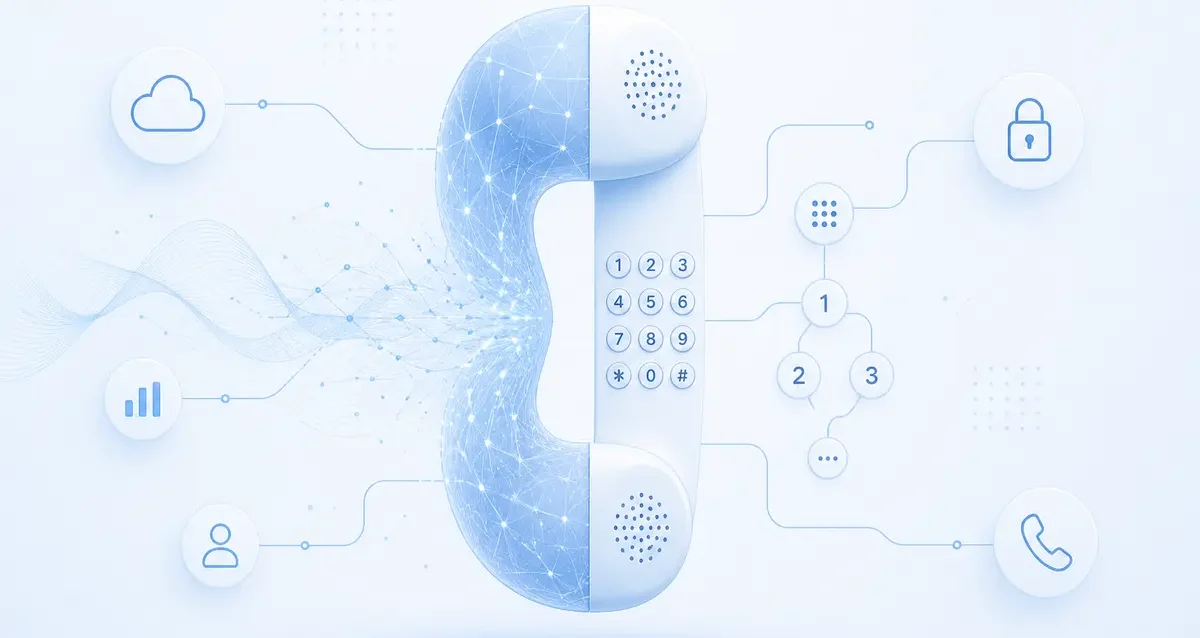
Defining AI voice agents and traditional IVR
AI voice agents are software systems that carry out human-like phone conversations. They convert speech to text, understand intent and entities, manage multi-turn dialogue, call APIs to fetch or update data, and respond with synthetic speech. Modern agents can clarify ambiguous requests, remember context across turns, and complete tasks end to end.
Traditional IVR (interactive voice response) systems guide callers through rigid trees of pre-recorded prompts. Callers press keys using DTMF (dual-tone multi-frequency) or speak short phrases that match a limited grammar. IVRs route calls, collect basic information, and hand off to humans when needed.
Core components of an AI voice agent architecture:
- Telephony interface for SIP trunks or contact center platforms, with call control and barge-in support.
- Real-time automatic speech recognition (ASR) to transcribe the caller’s speech.
- Natural language understanding (NLU) for intent classification and entity extraction.
- Dialog manager to track context, decide next actions, and handle clarifications.
- Integration layer to CRMs, order systems, ticketing tools, calendars, and knowledge sources.
- Text-to-speech (TTS) for natural, expressive responses; optional brand voice.
- Observability and analytics for transcripts, outcomes, and model performance.
Core components of a traditional IVR system:
- Telephony platform with call flow designer and routing rules.
- Prompt library of recorded messages; optional basic, grammar-based speech recognition.
- DTMF input handling to navigate menus and capture numeric data.
- Data dips for simple lookups (e.g., account verification) and queue placement.
- Reporting on call volumes, path selections, and transfers.
Brief evolution: Early IVRs in the 1980s focused on DTMF menus. Grammar-based voice recognition expanded options but remained brittle. Advances in neural ASR, NLU, and TTS, combined with cloud telephony, enabled conversational systems and today’s AI voice agents that can handle open-ended requests and complete complex tasks.
Where each is used in practice:
- Traditional IVR: quick self-service routing, hours/locations, simple account balance checks, PIN entry, outage announcements, after-hours messages.
- AI voice agents: troubleshooting with dynamic questions, order and returns management, appointment booking and rescheduling, lead qualification, benefit eligibility checks, and follow-up calls with calendar integration.
For organizations planning AI Voice Agent Development, Naga Info Solutions helps design the architecture, integrate with existing telephony and CRMs, and prototype use cases before large-scale rollout.
Core technical differences
Automatic speech recognition versus DTMF and legacy speech recognition: IVRs rely on DTMF or constrained grammars that only understand exact phrases. AI voice agents use neural, streaming ASR that supports free-form speech, interruptions (barge-in), accents, and noisy environments with far greater flexibility. This expands what callers can say and how naturally they can speak.
Natural language understanding and intent classification versus menu-based logic: IVR call flows are decision trees. Callers must map their goal to the menu’s wording. AI voice agents infer intent from language, extract entities (order number, product, date), and handle synonyms or indirect phrasing. This reduces friction and lets the system ask only the questions needed to complete the task.
Dialog manager and multi-turn context versus stateless IVR flows: IVRs treat each step independently. AI voice agents track context across turns—what was asked, what was confirmed, what’s still unknown—and adjust the conversation. They can manage interruptions (e.g., “Actually, use my other address.”), backtrack, or pursue parallel slots (identity, problem type, preferred time) in a single call.
Text-to-speech quality, voice cloning, and personalization: IVRs depend on pre-recorded prompts that are costly to update and lack personalization. AI voice agents respond with neural TTS that sounds natural, adapts prosody to content (e.g., numbers, names), and can reflect a brand voice. They can personalize tone and content based on caller profile and past interactions.
Integration layers such as APIs, telephony gateways, and middleware: Both approaches integrate with telephony, but AI voice agents typically sit within event-driven architectures. They consume and publish events, call REST/GraphQL APIs, interface with RPA where needed, and maintain real-time state across systems. Proper middleware and idempotent API design prevent duplicate actions when calls reconnect or switch channels. Naga Info Solutions implements these patterns, ensuring low-latency data access and reliable call control across SIP, CPaaS, and contact center platforms.
Capabilities compared side by side
Natural language conversation and multi-turn context retention: AI voice agents conduct open-ended dialogue, clarify intent, and remember what has been said. IVR interactions are linear and limited to menu paths.
Personalization, user profile lookups, and dynamic responses: AI voice agents retrieve caller records, preferences, and status in real time, then tailor next steps—e.g., “I see your delivery is scheduled for Thursday; would you like to reschedule?” IVRs can do simple lookups but struggle to adapt prompts dynamically without extensive branching.
Omnichannel continuity across chat, WhatsApp, and voice: AI voice agents can share context with chatbots and messaging channels, continuing a case initiated elsewhere and carrying over identity, transcripts, and unresolved tasks. Traditional IVRs generally lack cross-channel memory and treat every call as a new interaction.
Proactive outreach and scheduled call capabilities: AI agents can place outbound calls for appointment reminders, quote follow-ups, debt collection negotiations, or order delays, and reschedule automatically via calendar APIs. IVRs are primarily inbound, sometimes paired with basic outbound dialers for one-way notifications.
Analytics depth including conversational insights and intent-level reporting: AI voice agents generate transcripts, intent detection rates, entity coverage, step-by-step dialog outcomes, and escalation reasons. This enables targeted improvements. IVR analytics are often limited to menu path metrics, call durations, and transfer counts.
Naga Info Solutions connects voice agents to CRMs, scheduling systems, and data warehouses, and builds analytics pipelines that turn conversation data into operational insights without overhauling your existing stack.
Benefits and limitations of each approach
Advantages of AI voice agents:
- Improved customer experience through natural, flexible conversations that mirror how people actually speak.
- Automation of complex tasks that require multiple data fetches, validations, and conditional logic.
- Higher containment for nuanced requests, reducing transfers and queue times.
- Rapid content updates: change policy or pricing once and the agent adapts without re-recording prompts.
Limitations of AI voice agents:
- Data requirements: training and fine-tuning need representative intents, utterances, and edge cases.
- Ongoing maintenance: model drift, seasonal changes, and new products require continuous monitoring and updates.
- Latency and reliability: real-time ASR/NLU/TTS, network hops, and API calls must meet tight turn-taking budgets.
- Guardrails: ensuring safe, accurate responses and handling unknowns gracefully demands careful design and testing.
Advantages of traditional IVR:
- Simplicity and reliability: deterministic flows with predictable outcomes and minimal moving parts.
- Cost predictability: fewer compute-intensive components and straightforward maintenance.
- Strong fit for specific tasks: secure PIN entry, basic routing, and one-way announcements.
Limitations of IVR:
- Poor user experience for anything beyond simple menus; long trees lead to abandonment.
- Limited flexibility: small changes can require re-recording and re-testing entire paths.
- Minimal personalization and weak handling of ambiguous or multi-intent requests.
When a hybrid approach makes sense:
- Use IVR for front-door triage, compliance messages, or secure DTMF collection.
- Hand off to an AI voice agent for complex intents (troubleshooting, multi-step verification, scheduling) or when the caller asks for something not covered by menus.
- Route back to IVR or a human for edge cases or payments requiring strict keypad entry. This shares the reliability of IVR with the versatility of AI, while containing risk and cost.
Naga Info Solutions designs hybrid flows that respect existing IVR investments while introducing AI incrementally, focusing on high-impact intents first and building the operational guardrails needed for scale.
Business use cases and decision criteria
AI voice agents shine where conversation, context, and system actions matter. Traditional IVR is still effective for simple, repeatable tasks. Use the following patterns to match the problem to the right approach.
High‑value use cases for AI voice agents:
- Troubleshooting and guided diagnostics: Walk callers through device, app, or service issues; capture context; run backend checks; schedule a technician if needed.
- Order management: Track orders, modify delivery details, process returns, initiate refunds within policy, and follow up proactively.
- Conversational sales and qualification: Ask discovery questions, qualify prospects, provide tailored recommendations, and set appointments.
- Account support with personalization: Verify identity, fetch account data, and surface relevant options based on history and entitlements.
- Complex routing with context: Understand intent in natural language and route with enriched metadata for faster resolution.
Appropriate uses for IVR:
- Simple routing: “Press 1 for sales, 2 for support,” especially in low‑volume or small menu environments.
- After‑hours messages and announcements: Outage notices, holiday schedules, or static information.
- Secure PIN entry or payment capture: DTMF entry for PCI‑sensitive steps, even inside conversational IVR flows.
Decision factors to evaluate:
- Complexity of intents: Many intents, ambiguous phrasing, or policy‑driven decisions favor AI voice agents. A small, unambiguous menu favors IVR.
- Volume and variability: Higher call volume and intent variability justify AI Voice Agent Development investment; low volume or highly stable flows fit IVR.
- Compliance and data sensitivity: If you need strong controls for PII, payments, or health data, consider hybrid designs (IVR for PCI steps, AI for conversation).
- Budget and expected ROI: Compare cost per contained call with current agent costs, impact on AHT, and potential revenue uplift from better conversions.
- Integration readiness: If CRMs, order systems, and identity services are API‑ready, AI agents can deliver more value faster.
Industry‑specific examples:
- Finance: AI voice agents for balance inquiries, card replacement, dispute initiation, and personalized product upsell; IVR for PIN reset via DTMF and payment capture.
- Healthcare: AI agents for appointment scheduling, pre‑visit instructions, and benefits lookups; IVR for broadcast notices and simple department routing. Ensure HIPAA constraints are observed.
- Retail and e‑commerce: AI agents for order status, returns eligibility, warranty checks, and guided product recommendations; IVR for store hours and location info.
- Utilities and telecom: AI agents for outage triage, usage insights, plan changes, and payment arrangements; IVR for emergency notices and queue callbacks.
Prioritizing automation opportunities:
- Start with a call‑driver analysis. Identify top intents by volume and cost, plus those with high customer friction.
- Score each intent by business impact (cost to serve, revenue potential, CSAT lift) and feasibility (data availability, policy complexity, integration effort). A simple 2×2 or 1–5 scoring works.
- Sequence delivery in thin slices: high impact, medium effort first; keep PCI or HIPAA‑sensitive flows for later or run them in hybrid designs.
- Design for graceful human handoff early, so partial containment still delivers value.
Where helpful, Naga Info Solutions can run discovery workshops, build an intent taxonomy, and prototype AI voice agents that integrate with your CRM, order systems, and identity services. Our AI Voice Agent Development approach emphasizes measurable outcomes and safe hybridization with existing IVR where appropriate.
Implementation and integration guidance
A practical path from pilot to production: 1) Discovery and scoping: Define target intents, success metrics, guardrails, and handoff rules. Inventory telephony, CRM, and policy constraints. 2) Data readiness: Gather call recordings, chat logs, and disposition codes. Anonymize or redact PII and label a representative sample for training. 3) Intent taxonomy and dialog design: Group intents, define slots (key data points), error‑handling, and escalation paths. Draft prompts and knowledge references. 4) Model selection: Choose ASR, NLU/LLM, and TTS components based on language coverage, latency, cost, and compliance requirements. Consider on‑prem or VPC‑isolated options where needed. 5) Telephony integration: Connect SIP trunks or a CPaaS number; set up call routing, concurrency limits, and failover. Ensure call recording and consent flows are configured. 6) Backend integration: Implement APIs for CRM, ticketing, payments, order systems, and identity. Establish identity mapping via caller ID, OTP, or account lookup. 7) Prototyping and closed‑loop testing: Run dry‑runs with internal users, then beta with friendly customers. Measure ASR accuracy, NLU confidence, latency, and containment. 8) QA and guardrails: Add fallback prompts, knowledge boundaries, profanity filters, and rate limits. Validate PCI/HIPAA handling if applicable. 9) Analytics pipeline: Stream transcripts, events, and metrics to a warehouse. Enable redaction, session correlation, and dashboarding for KPIs. 10) Operational readiness: Configure monitoring, alerts, and incident response. Train supervisors and agents on handoff procedures and context sharing. 11) Phased rollout: Start with business hours or a subset of traffic. Ramp gradually while tuning intents and prompts. 12) Ongoing improvement: Review missed intents, add training data, update knowledge, and retrain models on a set cadence.
Telephony integration options:
- SIP trunks: Direct PBX or carrier connection; maximal control, requires telephony engineering and redundancy planning.
- CPaaS: Fast number provisioning, elastic concurrency, webhook‑driven events; simpler to start, ongoing usage fees.
- Contact center platforms: Integrate at the IVR or routing layer to share queues, agent states, and analytics; best for large operations.
CRM and backend integration best practices:
- Identity mapping: Use multi‑factor verification where needed (caller ID plus OTP). Cache session context securely to reduce re‑verification.
- Middleware abstraction: Add a thin orchestration layer to normalize diverse backends, handle retries, and apply business rules.
- Least‑privilege access: Scope API keys to specific actions. Centralize secrets and rotate regularly.
Data pipelines for logging, analytics, and model monitoring:
- Capture transcripts, intent classifications, slot values, NLU confidence, ASR word error indicators, and call outcomes.
- Redact PII in real time; store raw audio separately with restricted access and time‑boxed retention.
- Monitor drift: Track rising fallback rates or declining confidence as early warning signals.
Training data and model considerations:
- Start with historical calls to seed intents and utterances. Balance examples across accents and noise conditions.
- Augment training data with paraphrases and edge cases; label “out of scope” examples to reduce hallucinations.
- For voice quality, select TTS voices aligned with your brand; consider voice cloning only with explicit consent and clear policies.
Naga Info Solutions supports end‑to‑end delivery—from data preparation and intent design to telephony integration and analytics—combining AI Agent Development with robust n8n and API orchestration so your voice agent can take real actions reliably.
Cost ROI and measurement
Understand where costs accrue and how to measure value.
Cost components:
- Platform and licensing: Voice AI platform, ASR/NLU/TTS usage, and any per‑seat admin tools.
- Cloud compute and storage: Real‑time inference, logging, and transcript storage with retention controls.
- Telephony and carrier fees: Inbound minutes, outbound dialing, recording, concurrency, and phone numbers.
- Integration and implementation: Upfront build for APIs, dialog design, and QA.
- Ongoing operations: Support, prompt/knowledge updates, data labeling, and MLOps (model monitoring and retraining).
Staffing and maintenance:
- Product owner and conversation designer to manage scope and experience.
- Data/ML engineer for pipelines, drift monitoring, and evaluation.
- Integration engineer for APIs, telephony, and orchestration.
- QA and analytics for test coverage and KPI tracking.
KPI framework:
- Containment rate: Percentage of calls fully resolved by automation without human transfer.
- Automation rate: Share of total calls handled by the AI voice agent (even if transferred later).
- Average Handle Time (AHT): Compare human AHT vs. AI AHT and blended AHT post‑deployment.
- Escalation rate: Percentage of AI‑handled calls that require human intervention.
- CSAT or post‑call feedback: Simple 1–5 or NPS‑style prompts to gauge perceived quality.
- First Contact Resolution (FCR): For issues solved without call‑back or recontact.
Building a conservative ROI model:
- Baseline: Calculate current cost to serve (agent minutes x fully loaded cost per minute) plus telephony and overhead.
- Benefits: Combine savings from contained calls, reduced AHT on assisted calls (via better triage), and any incremental revenue from qualified sales.
- Investment: Sum platform, usage, implementation, and ongoing operations.
- Formula: Annual ROI = (Annual savings and uplift − Annual costs) ÷ Annual costs. Use conservative assumptions for containment and volume ramp.
Common costing pitfalls:
- Overestimating early containment; ramp accuracy with phased rollouts and retraining.
- Ignoring concurrency and peak minutes in carrier fees.
- Underaccounting for labeling and MLOps after launch.
- Forgetting long‑tail intents that add cost but limited incremental value—timebox and prioritize by impact.
Benchmarks and timelines:
- As planning targets, aim for meaningful value proof within 60–90 days of pilot start (on a limited intent set), and program‑level payback within two to four quarters for medium‑to‑high volume use cases, assuming disciplined prioritization, strong integrations, and steady tuning.
Naga Info Solutions can help build the ROI model, set measurable KPIs, and implement analytics that tie call events to business outcomes, so you can iterate with confidence and justify scaling decisions.
Security privacy and compliance
Treat live voice streams as sensitive data and design safeguards into every layer.
Handling PII and sensitive data:
- Minimize collection: Ask only for data you need; mask spoken identifiers where feasible.
- Real‑time redaction: Remove or hash names, addresses, account numbers, and card data in transcripts.
- Tokenization: Exchange sensitive fields for tokens; store originals in a secured system outside conversational logs.
- Access controls: Enforce least privilege with role‑based access, audit trails, and short‑lived credentials.
Recording, consent, and retention:
- Consent prompts: Play a clear notice and obtain dual‑party consent where required. Offer an opt‑out path from recording.
- Segmented recording: Pause or route to DTMF collection for payment steps; never store full PAN or CVV in audio or text.
- Retention policies: Time‑box audio and transcript storage; implement deletion workflows and support data subject requests.
Encryption and secure transport/storage:
- In transit: Use TLS for signaling and APIs; SRTP or secure media for voice streams.
- At rest: Encrypt with managed keys, rotate regularly, and separate keys from data.
- Network hygiene: Isolate workloads, restrict egress, and monitor for anomalous access patterns.
Regulatory considerations (high‑level):
- GDPR: Establish lawful basis, publish transparent notices, enable access/erasure requests, and respect data locality where applicable.
- PCI: Segregate card‑holder data flows; use IVR or DTMF suppression for payment capture; keep AI transcripts free of PAN/CVV.
- HIPAA: If handling PHI, execute BAAs, apply “minimum necessary,” and implement access auditing and breach notification protocols.
On‑premises vs. cloud tradeoffs:
- On‑prem/VPC: Greater control and data locality; higher upfront cost and operational burden; useful for strict compliance.
- Cloud: Faster time to value and elasticity; rely on vendor controls and certifications; design with strong network and key management.
Vendor and SLA expectations:
- Data use clauses: Clarify model training rights, data ownership, and deletion timelines.
- Security posture: Request independent audits, defined incident response, RTO/RPO, and uptime SLAs with penalties.
- Compliance alignment: Ensure support for consent tooling, redaction, and regional data residency needs.
Naga Info Solutions designs AI voice agents with privacy‑by‑default patterns—consent gating, real‑time redaction, segmented payment flows, encryption, and role‑based access—and can align deployments with GDPR, PCI, or HIPAA requirements in collaboration with your legal and security teams.
Testing monitoring and quality assurance
Effective AI Voice Agent Development depends on disciplined testing, robust monitoring, and a clear quality assurance loop. Treat the voice agent like any production system with user-facing impact: build a repeatable test harness, define measurable service objectives, and keep a tight feedback cycle from calls to training data.
Conversation testing and automated regression testing for dialogs
- Build an utterance library: diverse, real-world phrasings per intent, including slang, accents, background noise, cross-talk, and interruptions. Maintain it under version control.
- Unit-test NLU: verify intent classification and entity/slot extraction against the utterance library. Include negative examples to ensure the model does not overfit.
- Dialog regression: author scripted multi-turn paths (“golden paths” and edge cases) that verify context carryover, confirmation prompts, error handling, and barge-in behavior. Automate these tests with text-to-speech inputs to exercise ASR consistently.
- Telephony-in-the-loop tests: call the system over real carrier paths to validate DTMF capture (if hybrid), call setup time, echo/noise handling, and voicemail detection.
- Acceptance thresholds: define per-intent and per-journey thresholds (e.g., minimum confidence to proceed, maximum fallback rate, required success rate on critical flows). Use these as gates for release.
Performance testing under peak load and call concurrency monitoring
- Load modeling: size for peak concurrent calls, not averages. Include sudden spikes (e.g., outage notifications, promotions) and sustained busy-hour loads.
- Latency budgets: instrument ASR, NLU, dialog, integrations, and TTS segments. Set target round-trip turn latency (e.g., first token < X ms, total response < Y seconds) and track p50/p95/p99.
- Concurrency and scaling: validate horizontal scale of NLU/TTS services, API limits of CRMs and order systems, and telephony session capacity. Include failure injection (e.g., deliberately slow a backend) to test graceful degradation and fallbacks.
- Voice quality: test jitter, packet loss, and codec behavior. Confirm barge-in performance under degraded network conditions.
Monitoring error types, fallback triggers, and fallback coverage
- Core signals: ASR word error rate (proxy via phonetic distance), intent confidence distribution, fallback rate, repair success rate (successful recovery after a misunderstanding), interruption ratio, and abandonment.
- Integration errors: timeouts, 4xx/5xx from downstream systems, and stale data fetches. Correlate with user frustration markers (e.g., repeated requests, silence).
- Fallback taxonomy: classify why a fallback occurred (low confidence, integration failure, policy restriction, out-of-scope). Track coverage: how often recovery kept the user on self-serve vs forced escalation.
- Observability: use trace IDs across telephony, NLU, dialog, and backend calls so a single conversation can be reconstructed end-to-end.
A/B testing conversational variants and measuring lift
- Test levers: opening prompts, confirmation styles, persona/voice, disambiguation strategies, and turn-taking timing. Keep one variable per test when possible.
- Metrics: containment rate, successful task completion, average handle time (AHT), number of turns to resolve, transfer rate, and opt-out rate. Pair with post-call pulse surveys or simple DTMF/voice CSAT prompts.
- Safety guardrails: cap exposure for new variants, implement canary releases, and set automatic rollback on KPI regression.
Feedback loops for retraining, continual improvement, and model governance
- Data pipeline: capture transcripts, audio snippets where permitted, metadata (intent predictions, confidence, fallbacks), and business outcomes. Redact PII before analysis and training.
- Labeling workflow: sample calls by error class and business impact. Add hard negatives, accent variations, and new entity values. Version datasets and models, and keep a changelog of prompts and dialog policy updates.
- Drift monitoring: watch for distribution shifts in intents, entities, and ASR characteristics (e.g., seasonal terms). Trigger re-training or prompt tuning when drift exceeds thresholds.
- Governance: define approval gates for model releases, document risk assessments, and maintain rollback plans.
Alerting, incident response, and post-incident root cause analysis
- SLOs: set clear targets for containment, latency, and escalation accuracy. Alert on p95 latency breaches, fallback spikes, or transfer surges to specific queues.
- Runbooks: document standard responses for ASR degradation, TTS failures, or downstream outages (e.g., switch to summary prompts, route to IVR backup, or escalate to live agents).
- RCA: after incidents, analyze transcript samples, system traces, and capacity metrics. Capture remediation actions (training data updates, integration timeouts, scaling adjustments) with owners and timelines.
Where helpful, Naga Info Solutions can implement automated test harnesses, real-time analytics pipelines, and model monitoring/MLOps practices, connecting telephony, NLU, and backend systems so QA runs continuously rather than as a one-off before launches.
Migration strategies and hybrid models
A structured migration reduces risk while proving value incrementally. Most organizations move from menu-driven IVR to AI voice agents through controlled pilots and a hybrid period.
Phased migration roadmap, pilot design, and pilot KPIs
- Baseline: quantify your current IVR performance—call volumes by intent, containment, AHT, transfer reasons, and after-call work. Identify top candidate intents by volume and pain.
- Pilot scope: start with 2–5 high-volume, low-to-medium complexity intents (e.g., order status, simple troubleshooting, appointment management). Define acceptance criteria: minimum containment, maximum latency, and no negative impact to critical queues.
- Exposure controls: route a small percentage of eligible traffic (e.g., 5–20%) to the AI agent; expand as KPIs stabilize. Maintain fast rollback.
- Pilot KPIs: containment rate, AHT vs baseline, first-call resolution, transfer accuracy, and CSAT. Include operational signals like agent workload changes and peak-hour performance.
Parallel operation of IVR and AI agents with traffic routing controls
- Routing strategies: split traffic by percentage, time-of-day, caller segment (e.g., authenticated vs unknown), or DNIS/entry point. Keep clear rules for when to default to the legacy IVR or escalate to agents.
- Health-based routing: if the AI agent’s fallbacks or latency exceed thresholds, auto-shift more calls to IVR or live agents until recovery.
- Observability: tag calls by route so performance comparisons remain clean and decisions are evidence-based.
Hybrid flow design using IVR for simple paths and AI for complex intents
- IVR strengths: simple, deterministic paths like PIN entry, balance readouts, store hours, and legal disclosures. These can remain in IVR for speed and compliance.
- AI strengths: multi-turn, conditional workflows such as troubleshooting, order changes, plan comparisons, and nuanced qualification.
- Hand-offs: allow callers to say what they need. Route recognized simple intents to IVR; keep complex or ambiguous ones with the AI agent. Offer DTMF escape options for accessibility.
Fallback rules, graceful human handoff, and handover metadata practices
- Confidence thresholds: on low NLU confidence, clarify once, then route to a human to avoid frustration. Avoid looping.
- Metadata transfer: pass transcript-to-date, last intent hypothesis, collected entities, authentication status, and consent flags to the agent desktop. Include a concise AI-generated summary to reduce handle time—clearly labeled as system-generated.
- Post-handoff tracking: attribute outcome back to the originating AI session for training data and ROI analysis.
Training contact center staff and change management for go live
- Agent readiness: train agents to read handover summaries, validate data captured by the AI, and use consistent wrap codes so analytics remain comparable.
- Playbooks: provide guidance for when to re-route callers back to self-serve and how to capture phrasing the AI missed.
- Communications: inform internal stakeholders about rollout stages, KPIs, and escalation channels. Set expectations that quality improves over iterations.
Naga Info Solutions can help design hybrid architectures, implement routing logic, and create agent handoff metadata standards so migrations progress safely and measurably.
Vendor selection and procurement best practices
Choosing the right partner—or choosing to build—has lasting implications for cost, flexibility, and risk. Use a structured evaluation.
Vendor evaluation checklist covering integration, scalability, security, and SLA terms
- Integration: CRM/ERP connectivity, identity mapping, event/webhook support, data sync, and middleware compatibility. Telephony options (SIP trunks, CPaaS, or contact center platforms) and session transfer.
- Scalability and performance: proven concurrency, latency SLAs, regional availability, and traffic shaping. Ability to degrade gracefully.
- Conversational capabilities: ASR language/accent coverage, NLU intent/entity performance, dialog policy tools, interrupt handling, and TTS voice quality and personalization.
- Analytics and tooling: conversation insights, turn-by-turn metrics, transcript search, redaction, labeling workflows, and A/B testing support.
- Security and compliance: encryption in transit/at rest, role-based access, audit logs, retention controls, and compliance attestations relevant to your industry.
- Support model and SLAs: response times, uptime commitments, maintenance windows, and incident communication standards. Exit and portability provisions.
Questions to ask about model ownership, fine-tuning, and data usage rights
- Data rights: who owns call recordings, transcripts, prompts, and fine-tuned models? Can you export them?
- Training usage: can the vendor use your data to train global models? Is opt-out available by contract?
- Voice assets: if using cloned or branded voices, what are the licensing terms and revocation options?
- Customization: how are model versions tracked? Can you roll back? Can you bring your own models?
- Privacy: what redaction is applied pre-storage, and where? How are access keys and secrets managed?
Criteria for build versus buy including TCO and time to market
- Build when: voice automation is a strategic differentiator, you have in-house AI/telephony talent, strict data residency needs, or deep integration requirements.
- Buy when: speed to value matters, requirements align with product capabilities, or you prefer vendor-managed MLOps and compliance overhead.
- TCO factors: licensing, cloud compute, telephony, integrations, data labeling, testing infrastructure, model monitoring, and ongoing tuning. Include the cost of delays to value.
Proof of concept scope, success metrics, and pilot acceptance criteria
- Scope: 2–3 intents, real calls in a controlled segment, minimal necessary integrations (e.g., order lookup), and scripted guardrails for edge cases.
- Metrics: containment, AHT, transfer accuracy, latency, CSAT, and error breakdowns (ASR/NLU/integration).
- Acceptance: hit minimum thresholds for business-impacting KPIs, demonstrate safe failure modes, and show operational visibility for go/no-go decisions.
Common procurement mistakes to avoid during vendor negotiation
- Overweighting demo polish versus production readiness and observability.
- Underestimating telephony, data labeling, and integration costs.
- Accepting vague data-usage language or unclear model ownership.
- Skipping load tests and canary rollouts in the contract plan.
- Ignoring change management and agent training resources.
Naga Info Solutions supports both sides of the decision: we can run technical due diligence and POCs with vendors, or deliver bespoke AI voice agents and hybrid solutions when custom control and integration depth are priorities.
Frequently Asked Questions
An AI voice agent understands natural language, maintains context across turns, and integrates with business systems to complete tasks. Traditional IVR relies on structured menus and DTMF input, which is reliable for simple, linear flows but limited for multi-turn conversations.
Not usually. Keep IVR or conversational IVR for deterministic, short tasks like PIN entry or store hours, and use AI for complex, branching, or ambiguous requests. Many organizations run a hybrid model for the best customer experience and risk profile.
AI projects include costs for ASR/NLU/TTS, integrations, telephony, data labeling, analytics, and ongoing tuning. IVR is typically cheaper to set up for simple flows but scales poorly for complex use cases. A conservative ROI model should weigh call volume, task complexity, deflection potential, and maintenance overhead.
Focus on containment rate, AHT, transfer accuracy, first-call resolution, CSAT, and escalation rate. Pair these with cost-to-serve per call and agent workload changes to quantify savings and service improvements.
Use ASR models with broad accent coverage, maintain language-specific intent taxonomies, and test with representative utterances from your audience. Monitor accent-related errors, add hard negatives, and re-train regularly as call patterns evolve.
Watch for improper storage of raw audio and PII, unclear data usage rights, weak redaction, and over-permissive access to transcripts. Enforce encryption, strict retention, access controls, and contract terms that limit vendor data usage.
Start with a pilot on a small set of intents, run IVR and AI in parallel with traffic controls, expand coverage based on KPI performance, and keep IVR for simple or compliance-heavy steps. Ensure graceful human handoff and pass conversation context to agents.
Assess time to value, required customization, data residency/compliance needs, available talent, and long-term TCO. If AI Voice Agent Development is strategic and you need deep control, building (potentially with a partner like Naga Info Solutions) can make sense; otherwise, a capable vendor with strong integration and governance features is often faster to deploy.